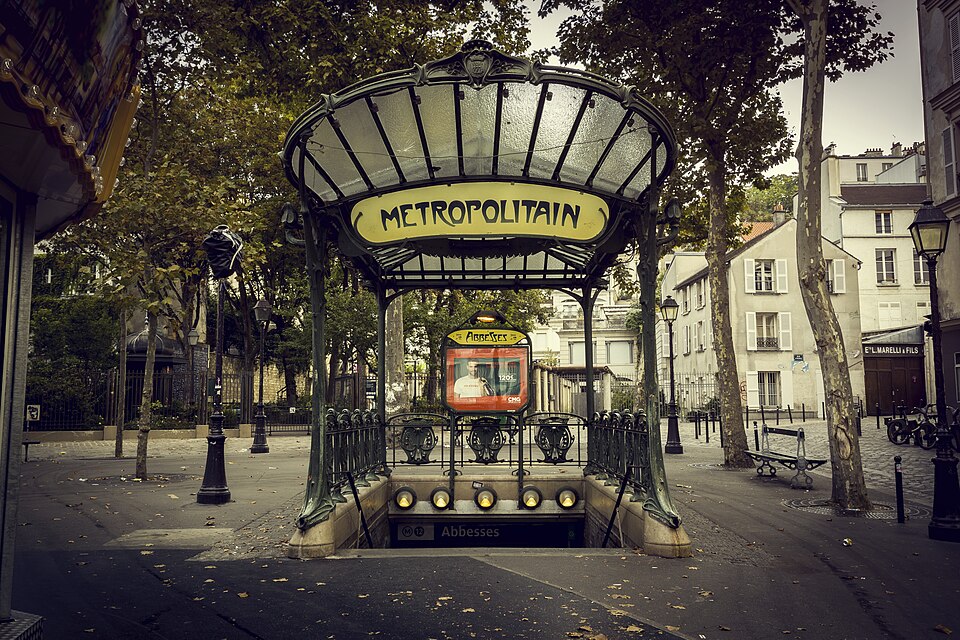
The short version
Paris has one of the densest transit networks in the world. Inside the city limits you are rarely more than a five-minute walk from a Métro station, and most visitors never need a car. Between the Métro, the RER suburban trains, buses, trams and your own feet, you can reach almost everything on a first trip for a few euros a day.
The system changed a lot recently. A fare reform in January 2025 replaced the old zone-based tickets with flat-price tickets, paper tickets are no longer sold and stop working in the Métro on December 15, 2026, the RoissyBus from CDG stopped running at the end of February 2026, and the Orlybus ended in March 2025. Many guidebooks and blog posts still describe the old setup. This page reflects what works in October 2026.
If you only remember three things: buy a €2 Navigo Easy card (or use your phone) instead of looking for paper tickets, use the €14 airport ticket for the RER B or Métro 14, and keep your ticket or card until you have left the station.
From Charles de Gaulle (CDG) to central Paris
CDG sits about 16 miles (25 km) northeast of central Paris, and nearly every nonstop flight from the US lands here. You have four realistic choices: the RER B train, a taxi, a ride-hailing car, or a pre-booked transfer. Cheaper bus combinations exist if you have time and light bags.
| Option | Price (2026) | Time to center | Best for |
|---|---|---|---|
| RER B train | €14 (about $16) airport ticket; covered by a Navigo week pass | About 30 min to Gare du Nord, 35–40 min to Châtelet | Solo travelers and couples with manageable bags |
| Taxi (flat fare) | €56 (about $63) Right Bank, €65 (about $73) Left Bank, for the whole car | 40–70 min depending on traffic | Families, groups of 3–4, heavy luggage, late arrivals |
| Uber, Bolt or other VTC | Varies with demand; often €45–85 (about $50–95) | 40–70 min | People who like app booking and a fixed quote |
| Pre-booked private transfer | Fixed quote, usually close to or above the taxi fare | 40–70 min | Meet-and-greet with a name sign, kids' car seats |
| Métro 14 + bus 9517 via Saint-Denis Pleyel | €2.55 + €2.05 = €4.60 (about $5) | About 50–60 min | Budget travelers with light bags |
| Bus 350 (Porte de la Chapelle) or 351 (Nation) | €2.05 (about $2.30) | 60–90 min | Very tight budgets, no rush |
| Night buses N140, N143 (Gare de l'Est/Gare du Nord) | €2.05 | 45–70 min | Arrivals or departures between about 1 and 5 a.m. |
RER B, step by step
The RER B is a regional train line that runs straight through Paris. From the airport it stops at Gare du Nord, Châtelet–Les Halles, Saint-Michel–Notre-Dame, Luxembourg and Port-Royal, so it reaches the Latin Quarter and Saint-Germain without a change. Trains generally run every 10–15 minutes from early morning until close to midnight.
- Follow signs for "Paris by train" or "RER B". From Terminal 2 the station is under the TGV station between 2C/2E and 2D/2F. From Terminal 1, take the free CDGVAL shuttle train to the "Aéroport CDG 1" RER station.
- Buy the Paris Region <> Airports ticket (€14, €7 for children 4–9) at a machine, at the ticket window, or in an app. It loads onto a Navigo Easy card (€2) or your phone. It is valid for 2 hours, one way, including a connection to the Métro.
- Any train heading into Paris works. All trains leaving the airport go toward the city.
- Keep your ticket handy. You need it to pass the exit gates, and inspectors do work this line.
Watch out
The RER B is the line Paris locals complain about most. Weekend and late-evening engineering works sometimes replace trains with buses, and in summer 2026 the line was cut between CDG and central Paris for three weeks. Check the Bonjour RATP app or the departure boards a few days before you fly home. Thieves also target tired travelers with bags on this line, so keep your phone in a front pocket and your bags between your knees.
Taxis from CDG
Official taxis wait at marked ranks outside each terminal. By law the ride to or from Paris costs a flat €56 to the Right Bank or €65 to the Left Bank, set by government decree for 2026. The price covers up to four passengers and their luggage. A fifth passenger adds €5.50, and there is no luggage surcharge in Paris. Drivers must take cards, so you do not need euros in cash.
"Right Bank" means north of the Seine (arrondissements 1–4, 8–12 and 16–20); "Left Bank" means south of it (5–7 and 13–15). If your hotel is on the islands, ask the driver before you set off; the Île de la Cité and Île Saint-Louis are usually treated as Right Bank.
Watch out
Ignore anyone in the arrivals hall who walks up and offers you a taxi. Licensed taxis never solicit inside the terminal. These touts drive unlicensed cars and routinely charge €100–150 for the same ride. Walk outside to the official rank, where a real Paris taxi has a "TAXI PARISIEN" roof light and a meter.
Uber, Bolt and pre-booked cars
Ride-hailing apps work at CDG and pick up at designated zones in the parking structures, which can be a 5–10 minute walk from baggage claim. Prices float with demand, so a taxi's flat fare often wins at busy times. Pre-booked transfer companies, including big international ones like Welcome Pickups and Blacklane plus dozens of local firms, meet you inside with a sign. They make the most sense when you need child seats or are a group of five or more in a van.
The cheap bus combinations
The RoissyBus from Opéra stopped running on February 28, 2026, after more than 30 years, and the Le Bus Direct coaches ended earlier. The budget alternatives are slower. The best is to ride Métro line 14 north to Saint-Denis Pleyel, then take express bus 9517 to Roissypôle at the airport, about 30 minutes from Saint-Denis. You need a Métro ticket for the first leg and a bus-tram ticket for the second. Buses 350 and 351 are cheaper still but crawl through the suburbs.
CDG Express: coming March 2027
A dedicated nonstop train from Gare de l'Est to CDG Terminal 2 is scheduled to open on March 28, 2027. Announced details: a 20-minute ride every 15 minutes from about 5 a.m. to midnight, and a one-way fare of about €25 (about $28), with children under 16 riding free with an adult. It is not running yet, so ignore any website that sells tickets for it now. The fare grid was still being finalized in late 2026; check cdgexpress.com before a spring 2027 trip.
Insider tip
CDG is also renaming its terminals in March 2027, timed with the CDG Express launch. Terminal 2E becomes Terminal 5, 2F becomes 6, 2G becomes 7, 2A/2C become 3, 2B/2D become 4, and today's Terminal 3 becomes Terminal 2. Terminal 1 keeps its name. If you fly in spring 2027 or later, read your boarding pass carefully and double-check which terminal you need.
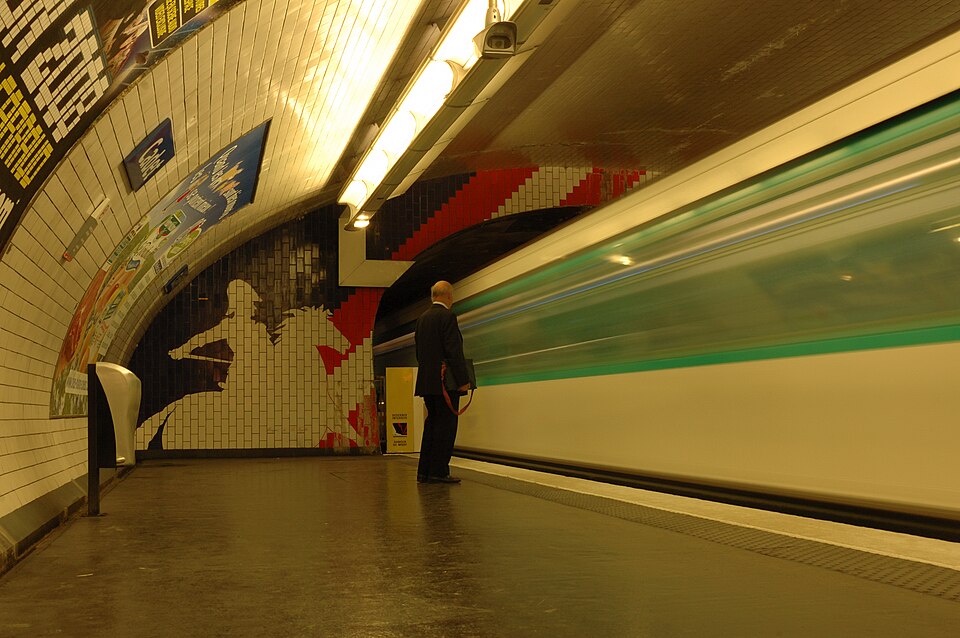
From Orly and Beauvais airports
Orly is about 8 miles (13 km) south of the city. It handles some US flights (mostly on smaller and low-cost carriers) and many domestic and European ones. Since Métro line 14 reached Orly in June 2024, it has become the easiest Paris airport to leave.
| Option | Price (2026) | Time to center | Notes |
|---|---|---|---|
| Métro line 14 | €14 airport ticket; covered by a Navigo week pass | About 25 min to Châtelet | Driverless trains every few minutes; stops at Gare de Lyon, Châtelet, Pyramides, Madeleine, Saint-Lazare |
| Orlyval shuttle + RER B | €14 airport ticket (Navigo week pass not valid on Orlyval) | About 35–40 min to Châtelet | Change at Antony; useful for the Latin Quarter |
| Tram T7 + Métro 7 | €2.05 tram + €2.55 Métro | About 60 min | Tram leaves from Orly 4, ends at Villejuif–Louis Aragon |
| Taxi (flat fare) | €45 (about $50) Right Bank, €36 (about $40) Left Bank | 25–45 min | Official ranks outside each terminal |
| Uber, Bolt, VTC | Varies with demand | 25–45 min | Pick-up zones signed in the terminals |
| Night buses N22, N31, N131, N144 | €2.05 | About 60 min | Roughly 12:30–5:30 a.m. |
The Orlybus that used to run to Denfert-Rochereau ended on March 3, 2025. Orly's terminals are numbered 1 to 4 (Orly 1–2 were the old West terminal, Orly 4 the old South terminal); a free shuttle links them, and the line 14 station sits next to Orly 3, a short walk from all of them.
Orly is also the first place in Paris where you can tap a regular contactless bank card on the gates. Since June 30, 2026, if you ride line 14 to the airport without an airport ticket, you can tap a contactless bank card on the exit gates at Orly to pay the airport fare, listed at €14 (about $16). For the trip into Paris, you still need a ticket loaded on a card or phone.
Beauvais (BVA)
Beauvais–Tillé is a low-cost airport used by Ryanair and Wizz Air, about 53 miles (85 km) north of Paris. Despite the name "Paris Beauvais", it is far from the city. The standard link is the airport's own shuttle coach to Porte Maillot on the western edge of Paris, timed to flights and taking about 1 hour 15 minutes without traffic. Buy tickets on the airport's website for the current fare. A taxi has no flat fare and runs well over €150, so it only makes sense for a group. Factor the time and cost in when a Ryanair fare looks cheap; for most Americans, flying from CDG or Orly, or taking a train (see trains), is simpler.
Tickets and passes in 2026
In January 2025 the region scrapped its confusing zone system for single tickets. A single ticket now costs the same for two stops as for a ride out to Versailles or Disneyland. There are two families of tickets: one for Métro, RER and trains, and one for buses and trams. The airports are the one exception, with their own ticket.
| Ticket or pass | Adult price | Child 4–9 | What it covers |
|---|---|---|---|
| Métro-train-RER ticket | €2.55 (about $2.90) | €1.30 | One trip on Métro, RER, suburban trains and the Montmartre funicular anywhere in the region except the airports; transfers within the rail network for 2 hours |
| Bus-tram ticket | €2.05 (about $2.30) | €1.05 | Buses and most trams, with bus-to-bus or bus-to-tram transfers for 90 minutes; no Métro |
| Paris Region <> Airports ticket | €14 (about $16) | €7 | One way to or from CDG (RER B) or Orly (Métro 14 or Orlyval + RER B), with onward Métro and RER connections for 2 hours |
| Navigo Jour (day pass) | €12.30 (about $14) | Full price only | Unlimited travel on one calendar day, all modes, all zones, airports excluded |
| Navigo Semaine (week pass) | €32.40 (about $36) | Same price | Unlimited travel Monday 00:00 to Sunday 23:59, all zones, including RER B to CDG and Métro 14 to Orly (not Orlyval) |
| Navigo Mois (month pass) | €90.80 (about $102) | Same price | Unlimited travel for a calendar month |
| Paris Visite 1/2/3/5 days | €30.60 / €45.40 / €63.80 / €78 | Half price | Unlimited travel including airports for consecutive days, plus minor discounts |
Children under 4 ride free. Ticket books (the old "carnet" of 10) no longer carry a discount, so there is no saving in buying in bulk. Prices are set by Île-de-France Mobilités each January, so expect small increases in 2027.
Different from home
Unlike the New York subway or the DC Metro, a Métro ticket does not let you transfer to a bus, and a bus ticket does not get you into the Métro. If you ride the Métro and then a bus, you pay twice. A week pass covers everything, which is one reason it is such good value.
Paper tickets are on the way out
The little cardboard tickets that Paris used for decades stopped being sold in November 2025 and no longer work on buses and trams. In the Métro and RER they are accepted only until December 15, 2026, and leftover tickets can be exchanged for digital ones until January 14, 2027, with no refunds. Everything else lives on a rechargeable card or your phone. If someone tries to sell you a paper ticket outside a station, walk away.
Navigo Easy: the card most visitors need
The Navigo Easy is a contactless card that costs €2 (about $2.25), needs no photo or name, and can hold single tickets, a day pass, an airport ticket or a Paris Visite pass. Buy it at a station ticket window or ticket machine, then top it up at any machine. Each traveler needs their own card, including kids. One limitation: it cannot hold the weekly Navigo Semaine, and it cannot hold Métro tickets and an airport ticket at the same time, so use up one kind before loading the other.
Navigo Découverte: for the weekly pass
To get the Navigo Semaine on a card, you need a Navigo Découverte, which costs €5 at station ticket windows. Bring a color passport-style photo about 1.2 by 1 inch (3 cm tall by 2.5 cm wide); there are photo booths in many big stations. Write your name on the card and stick the photo on. The card is personal, and inspectors can ask to see it. You can also load the weekly pass on your phone through the official apps, which ask you to upload a photo instead.
The catch is the calendar. The week pass always runs Monday to Sunday, whatever day you buy it. You can buy it from the Friday before until Thursday of the week you use it. Arrive on a Saturday and it covers only two days.
Which should you buy?
- In Paris Monday to Sunday, or most of a Monday-to-Sunday week: Navigo Semaine. Example: six days with an airport trip each way and three Métro rides a day costs €28 + 18 × €2.55 = €73.90 in single tickets, versus €32.40 plus a €5 card. You save about €36 (about $41) per person.
- A long weekend (Friday to Monday): Navigo Easy loaded with single tickets, plus the airport ticket each way. Most visitors take three to five rides a day, so €8–13 a day.
- One very busy day: A Navigo Jour at €12.30 beats single tickets once you take five or more Métro rides (5 × €2.55 = €12.75). It does not cover the airports.
- Paris Visite: rarely a good deal. A 3-day pass costs €63.80; three days of five rides plus two airport trips would cost about €66 in single tickets, and most people ride less. Its bundled discounts are small.
Save money
Paris is very walkable, and many visitors overestimate how often they will ride. Walk between nearby sights and use the Métro for longer hops and tired feet. Under-26 and senior discounts exist only for residents, so Americans pay full fare at any age, except children under 10.
Paying with your phone or a bank card
You can skip plastic entirely and keep tickets on your phone. There are two official apps: Bonjour RATP (from the Métro operator) and Île-de-France Mobilités (from the transit authority). Both plan routes with real-time departures, and both sell tickets.
- iPhone: Apple Wallet supports Navigo. You can add a Navigo card in Wallet and buy tickets and passes with Apple Pay, then tap your phone or watch on the purple reader. It works even with the phone locked, using Express Mode.
- Android: Buy in either app; your phone needs NFC switched on. Validate by holding the phone to the reader.
- US phone numbers: Some travelers have trouble with the apps' text-message account verification on a US number. If it fails, a €2 Navigo Easy card from a ticket window works just as well. See staying connected for eSIM options.
Tapping a US credit card
Open-loop tap-to-pay, the system that lets you tap a Visa or Mastercard at the gate in London or New York, is arriving in Paris in stages. As of October 2026 it works on buses in Paris and the inner suburbs, on the Montmartre funicular, and at the Orly airport gates of Métro line 14. A bus or funicular tap costs €2.55, more than the €2.05 bus-tram ticket, and includes no transfers. One card can pay for you and up to four companions (tap once per person), and your bank sees one combined charge at the end of the day, usually posted a day or two later.
The Métro itself does not take bank cards yet. The rollout is scheduled for line 1 in July 2027, then lines 4 and 14 and the new suburban lines later in 2027, lines 7 and 12 by the end of 2028, and the whole rail network by 2030. Until then you need a ticket on a card or phone.
Insider tip
Station ticket machines take cards. Most accept chip cards and many accept contactless, but some still ask for a PIN, so know your card's PIN before you leave home. Machines take coins but often refuse bills. See money and cards.
How to ride the Métro and RER
The Métro has 16 lines, numbered 1 to 14 plus two short branches, 3bis and 7bis. Each has a color and number, and each direction is named for its last stop. To go from Châtelet to the Louvre on line 1, you follow signs for "Direction La Défense"; coming back, "Direction Château de Vincennes". Learn to think in end-of-line names and the system becomes easy.
- Find your line and the terminus in the direction you want, using a map or the app.
- Tap your card or phone on the purple Navigo disc at the turnstile and push through when the light turns green. Hold it there for a second.
- Follow the line number and "Direction" signs to the right platform. Screens show minutes until the next two trains.
- On older trains, doors do not open automatically. Lift the latch or press the button when the train stops.
- To change lines, follow orange "Correspondance" signs with the next line's number. Some transfers, like Châtelet or Montparnasse, involve long corridors and moving walkways.
- To leave, follow blue "Sortie" signs. Big stations have several exits; the street name on each sign tells you where you will surface.
- Keep your ticket or card until you are out on the street.
Different from home
Paris has no conductors checking tickets on board, but roving inspectors (contrôleurs) check you anywhere in the system, including corridors and exits. They wear uniforms or plain clothes with an armband. The fine for riding without a valid ticket is €70 (about $78) if paid on the spot, rising sharply if you pay later. "I'm a tourist" does not work. If you have a pass but forgot to tap it, the fine is smaller but still applies.
Métro etiquette
- Fold-down seats near the doors (strapontins) are fine to use when the car is empty. Stand up when it fills.
- Stand on the right on escalators; people walk up on the left.
- Rush hours run roughly 8–9:30 a.m. and 5:30–7:30 p.m. Avoid lines 1, 4, 13 and the RER A and B then if you have bags or a stroller.
- Many stations have long staircases and no elevator. Pack light if you plan to ride with luggage.
- Talk quietly. Parisians notice loud conversations on trains more than Americans tend to expect.
The RER
The five RER lines (A to E) are faster suburban trains that cross the city with only a few stops in the center. They are useful for long hops (the RER A goes from Châtelet to the Arc de Triomphe area in under 10 minutes) and for day trips: the RER C to Versailles Château Rive Gauche and the RER A to Marne-la-Vallée for Disneyland Paris both cost a single €2.55 ticket since the 2025 reform. RER stations often have exit gates, so you need your ticket to get out. Check the platform screen: one RER platform can serve several branches, and not every train stops everywhere. See day trips for Versailles and other outings.
Zones
The region is still divided into five zones (Paris is zone 1, CDG is zone 5), but since 2025 they matter only for residents' discounted passes. Single tickets, the Navigo Jour and the "all zones" week pass ignore them. You can safely forget about zones.
Buses, trams and getting home late
Buses are slower than the Métro but show you the city, avoid stairs, and are all step-free with a ramp. Board at the front, tap your card, phone or contactless bank card on the reader, and press the red "Arrêt demandé" button before your stop. Screens and announcements name each stop. Bus 69 (Champ de Mars to Gambetta, past the Invalides, the Louvre and the Marais) and bus 72 (along the Right Bank quays) make good cheap sightseeing rides.
Trams mostly run around the edge of the city; the T3a and T3b ring Paris along the boulevards des Maréchaux, and tram T7 serves Orly. The bus-tram ticket covers them. Bus lanes are also used by taxis and bikes, so look both ways before stepping off a curb.
Last trains and night buses
The Métro starts around 5:30 a.m. Last trains reach the end of the line at about 1:15 a.m. Sunday to Thursday and about 2:15 a.m. on Friday, Saturday and the night before public holidays. The last train passes central stations earlier than that, so check the app for your station. RER lines start earlier, around 4:30–5 a.m.
From about 12:30 to 5:30 a.m., the Noctilien night buses (numbered N01 onward) take over, radiating from hubs at Châtelet, Gare de l'Est, Gare de Lyon, Montparnasse and Saint-Lazare. They run every 15–30 minutes on busy routes and take the bus-tram ticket or your pass. They are safe enough but can be rowdy on weekends; after 1 a.m., many visitors simply take a taxi.
Taxis, Uber and Bolt
Paris has about 18,000 licensed taxis, most of them now hybrid or electric cars. A taxi is free when its roof light is green and taken when it is red. You can hail one on the street, find one at a marked taxi stand (look for blue "Taxis" signs at stations and big intersections), or book through the G7 app, the largest fleet. Near a stand, drivers usually expect you to go to the stand.
- Meter fares: a pick-up charge of a few euros, then roughly €1.30–1.76 per kilometer depending on the time of day (more at night and on Sundays). The minimum fare is €8 (about $9).
- Booking supplement: €4 for an immediate booking or €7 for an advance booking through an app or phone.
- Extra passengers: taxis take up to four; a fifth costs €5.50 where the car allows it. Many taxis are small, so a family of five with suitcases should book a van.
- Payment: every Paris taxi must accept cards, whatever the amount. A driver who claims the machine is broken is breaking the rules; you can ask for a receipt (mandatory over €25) and report it.
- Tipping: not expected. Rounding up or adding a euro or two for help with bags is plenty.
Uber and Bolt both operate widely, and the G7 app works much like them with licensed taxis. Ride-hailing cars (called VTC) must be booked through an app and cannot be hailed. At night or in the rain, prices on Uber can spike past a metered taxi. The flat airport fares make official taxis the safer bet for airport runs.
Insider tip
Taxis are hard to find in the rain, at Friday rush hour and between about 1 and 2 a.m. when the Métro closes. Book through the G7 app ahead of time if you have a dinner reservation or an early train.
Vélib bike share and biking safely
Paris has transformed itself for bikes over the last decade. There are now hundreds of miles of protected lanes, including the Rue de Rivoli, which is closed to private cars and runs wide bike lanes from the Concorde to the Bastille. Riding along the Seine quays or the Canal Saint-Martin on a mild day is one of the best ways to see the city.
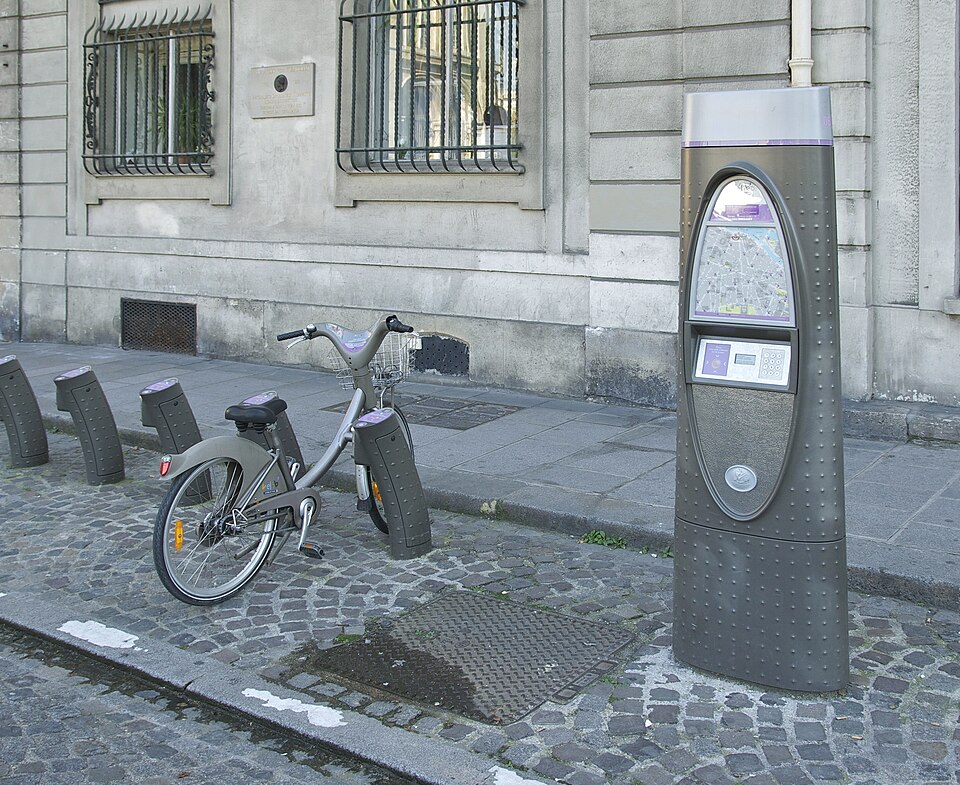
Vélib' Métropole is the public bike share, with more than 1,400 stations. Green bikes are mechanical; blue ones are electric. Sign up in the Vélib' app with a credit card.
| Vélib' offer | Price | What you get |
|---|---|---|
| Ticket-V | €3 (about $3.40) | One ride up to 45 min, mechanical or electric |
| 24-hour Classic | €5 (about $5.60) | Unlimited 30-minute rides on mechanical bikes; e-bikes extra |
| 24-hour Electric | €10 (about $11) | 60 min per ride on mechanical, 45 min on electric (5 e-bike rides included) |
| 3-day pass | €20 (about $22) | Same as above for 72 hours; up to five bikes at once |
Extra time costs €1 per 30 minutes on a mechanical bike and €2 on an electric one. To avoid charges, dock the bike at any station before the time runs out and take another. Make sure the dock shows a green light, or you may be billed until it registers the return. Lime, Dott and Voi rent e-bikes through their apps too. Rental e-scooters were banned from Paris in September 2023 after a citywide vote, so you will not find them in the city.
Riding safely
- Helmets are required only for children under 12, but they are a good idea; Vélib does not supply them.
- Stay in marked lanes. Many bus lanes are shared with bikes and taxis, so expect a bus behind you.
- At some lights, a small sign with a bike and arrow lets cyclists turn right or go straight on red while yielding. Without the sign, stop.
- Do not ride on sidewalks. Police fine cyclists for it, and pedestrians will not thank you.
- Rush hour on the main bike routes is intense, with fast commuters. Ride on weekends or mid-morning if you are rusty, and pick the Seine riverbanks or the canal for a gentler start.
Walking and the Batobus
Paris inside the ring road covers about 41 square miles (105 km²), about a third the size of Philadelphia. The walk from the Louvre to the Eiffel Tower along the Seine is about 2.5 miles (4 km), roughly an hour at a sightseeing pace. Most visitors walk 8–12 miles a day without noticing, so bring broken-in shoes. See the Paris overview for how the city is laid out.
- Cross at crosswalks and on the green figure. Drivers generally stop at crossings, but scooter riders and delivery bikes often do not.
- Watch for cyclists in contraflow lanes on one-way streets; they come from the direction you do not expect.
- Street signs are on the corner buildings, on blue enamel plaques with the arrondissement number above the name.
Batobus
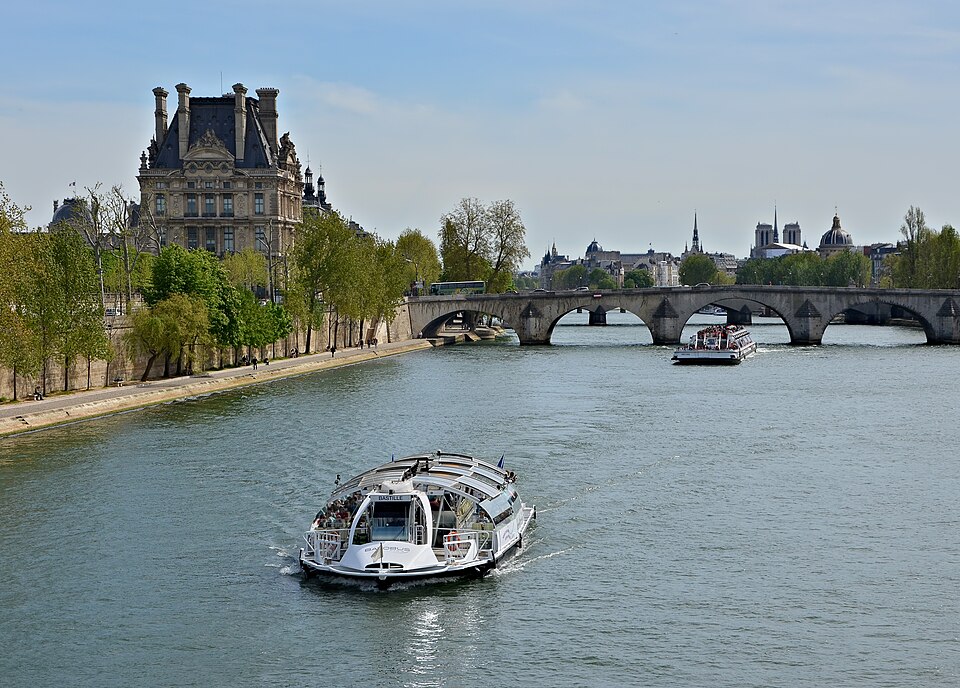
The Batobus is a hop-on, hop-off river shuttle with nine stops: Eiffel Tower, Invalides, Musée d'Orsay, Saint-Germain-des-Prés, Notre-Dame, Jardin des Plantes, Hôtel de Ville, Louvre and Champs-Élysées (Concorde). A 24-hour pass costs €23 (about $26) and a 48-hour pass €27 (about $30) for adults, with reduced prices for children 3–15; transit passes are not valid. Boats run from 10 a.m., with the last departures from the Eiffel Tower between 5 and 8 p.m. depending on day and season. A full loop takes about 1 hour 45 minutes, so treat it as a scenic ride, not fast transport. Book at batobus.com. For narrated sightseeing cruises, see Paris sights.
Accessibility
The Métro was built from 1900 onward and is largely inaccessible to wheelchair users. Most stations have stairs, and few have elevators. The exception is line 14, which is fully step-free, including its 2024 extensions to Orly and Saint-Denis Pleyel. The newer suburban stations of the Grand Paris Express are also being built step-free.
- Buses: every Paris bus line is accessible, with low floors, a ramp and a wheelchair space. For most wheelchair users, buses are the way to get around.
- Trams: fully accessible, level boarding.
- RER A and B: many stations have elevators, but not all, and the gap to the train varies. Staff can help with ramps at some stations if you ask.
- Planning: the Bonjour RATP and Île-de-France Mobilités apps can filter routes for step-free travel, and Île-de-France Mobilités runs an accessibility information service called Infomobi.
- Taxis: G7 has a fleet of wheelchair-accessible vehicles bookable in its app; wheelchairs travel at no extra charge.
Strollers face the same stairs, plus narrow turnstiles; ask for the wide gate or use buses. See travel by interest for more on accessible travel and Paris with kids for family logistics.
The six main train stations
Paris has no central station. Each big terminal serves a slice of France, so the station you need depends on where you are going. All are on the Métro, and the walk between Gare du Nord and Gare de l'Est takes about 10 minutes. For tickets, rail passes and booking tips, see trains in France.
| Station | Main destinations | Region guides |
|---|---|---|
| Gare du Nord (10th) | Eurostar to London, Brussels and Amsterdam; TGV to Lille; RER B to CDG | North |
| Gare de l'Est (10th) | Reims, Strasbourg, Metz, Nancy; trains to Germany; CDG Express from 2027 | Champagne, Alsace-Lorraine |
| Gare de Lyon (12th) | Lyon, Dijon, the Alps, Avignon, Marseille, Nice; Switzerland and Italy | Lyon, Burgundy, Alps, Provence, Riviera |
| Gare Montparnasse (14th–15th) | Rennes and Brittany, Tours, Bordeaux, Toulouse, Biarritz and the Basque coast | Brittany, Loire, Bordeaux, Basque Country |
| Gare Saint-Lazare (8th) | Rouen, Caen, Bayeux, Le Havre, Deauville; Vernon for Giverny | Normandy |
| Gare d'Austerlitz (13th) | Orléans, Blois and the eastern Loire, Limoges, Toulouse on slower Intercités; most night trains | Loire, Occitanie, Dordogne |
Some low-cost Ouigo high-speed trains leave from suburban stations such as Marne-la-Vallée–Chessy (by Disneyland) or Massy TGV, and a few slower trains use Paris-Bercy next to Gare de Lyon. Read your ticket carefully.
Luggage storage
If you check out in the morning and leave in the evening, ask your hotel to hold your bags; almost every hotel does this for free. Most of the large train stations have a left-luggage office or lockers (consigne), though they can close during heightened security alerts. Apps such as Bounce, Nannybag and LuggageHero let you drop bags at partner shops and hotels across the city for a daily fee, which is handy near the Eiffel Tower or before a late flight.
Pickpockets and scams on transit
Violent crime on Paris transit is rare, but pickpocketing is common and well organized. Thieves work where tourists are distracted: at doors as they close, on packed platforms and at ticket machines. The worst spots:
- Line 1 through the Louvre, Concorde, Champs-Élysées and Bastille
- Line 4, especially Châtelet, Les Halles, Gare du Nord and Barbès
- RER B between CDG and Gare du Nord, where travelers have luggage and jet lag
- Line 2 at Anvers and Barbès (for Sacré-Cœur) and Pigalle
- Line 6 at Trocadéro and Bir-Hakeim (for the Eiffel Tower)
- Châtelet–Les Halles, the biggest underground station in Europe, and its long corridors
Keep your phone in a front pocket or zipped bag, not in your hand by the doors, which is how most phone snatches happen. Be wary of anyone who "helps" at a ticket machine or offers to swipe you through a gate, of groups who crowd you at the doors, and of anyone selling tickets outside a station. See safety and scams for the full rundown and what to do if your passport is stolen.
Watch out
Métro and RER strikes (grèves) still happen a few times a year, usually announced days in advance. The RATP keeps some service running on most lines, and line 14 and the driverless line 1 are rarely affected. Check the Bonjour RATP app each morning during a strike and plan to walk or bike more.
Add it to a route in the trip builder, or ask us to plan the hotels, trains and guides for you.