Overview
The Canary Islands are a Spanish region in the Atlantic, about 60 miles (100 km) off the coast of Morocco and some 1,100 miles (1,750 km) from Madrid. They are volcanic, and the landscapes show it: black sand beaches, lava fields, pine forests on the slopes of extinct and active volcanoes, and Mount Teide, the highest peak in Spain. Steady trade winds and the cool ocean keep the climate mild all year. Europeans come by the millions in winter for sun.
There are eight inhabited islands. Most visitors go to the big four: Tenerife, Gran Canaria, Lanzarote and Fuerteventura. The smaller western islands, La Palma, La Gomera and El Hierro, are quieter, greener and wonderful for walking. The eighth, La Graciosa, is a tiny island off Lanzarote with sand tracks instead of paved roads.
For Americans, the Canaries are less familiar than the Caribbean or Hawaii, and that is part of the appeal. They feel Spanish, with Latin American echoes in the accent and the food, but they are their own place, with a culture shaped by centuries of trade and emigration across the Atlantic. Many Venezuelan, Cuban and Puerto Rican families trace roots here.
Different from home
The Canaries are one hour behind mainland Spain, on the same time as London and Lisbon. Check flight times carefully when you connect through Madrid or Barcelona; your boarding pass shows local time at each end. The islands are part of Spain, the EU and the Schengen Area, so the usual entry rules apply.
Choosing an island
| Island | Best for | Landscape | Airport |
|---|---|---|---|
| Tenerife | Variety, Teide, hiking, whale watching, families | High volcano, green north, dry south | Tenerife South (TFS), Tenerife North (TFN) |
| Gran Canaria | A real city, dunes, mountain villages, LGBTQ+ scene | Round "continent in miniature" | Gran Canaria (LPA) |
| Lanzarote | Volcanic scenery, art and architecture, wine, couples | Black lava, white villages | Lanzarote (ACE) |
| Fuerteventura | Long beaches, windsurfing and kitesurfing, quiet | Desert, dunes, endless sand | Fuerteventura (FUE) |
| La Palma | Hiking, stargazing, nature | Steep, green, forested | La Palma (SPC) |
| La Gomera | Walking, laurel forest, slow travel | Deep ravines, terraces | Ferry from Tenerife |
For a first visit, Tenerife is the easiest choice: it has had the only US nonstop, and it has the most variety and Teide. Pair it with a few days on La Gomera by ferry. If you want beaches and quiet, choose Fuerteventura; for striking design and landscapes, Lanzarote.

Tenerife
Tenerife is the largest and most populous island, and it is really two islands in one. The south, around Playa de las Américas, Los Cristianos and Costa Adeje, is dry, sunny and built up with resorts. The north, around Puerto de la Cruz and the old capital of La Laguna, is greener, cooler and more Spanish, with banana plantations and colonial towns.
Mount Teide
Teide National Park, a UNESCO World Heritage site since 2007, surrounds the volcano Teide, 12,188 feet (3,715 m) high, the highest point in Spain. The park is a high plateau of lava flows and strange rock formations, like the Roques de García, about 7,000 feet (2,100 m) up. The drive up from either coast takes about an hour.
- The Teide cable car rises to an upper station at 11,663 feet (3,555 m). Buy timed tickets at volcanoteide.com; it closes in high winds or ice, sometimes for days.
- The last 525 feet (160 m) or so to the summit crater are on the Telesforo Bravo trail, which you must book on the Cabildo de Tenerife's Tenerife ON platform, which has managed the summit since August 2025. Since January 19, 2026, slots between 9 a.m. and 5 p.m. cost €15 (about $17) for visitors from outside the Canary Islands, free for children under 14. New slots open on Mondays up to 28 days ahead and sell out, and bookings cannot be changed or refunded unless the trail closes for weather or the cable car is not running. Without one, you can walk two shorter trails from the upper station to viewpoints.
- Stargazing tours run on the plateau, which is one of the best observatory sites in the world.
Watch out
At the upper cable car station you are at nearly 12,000 feet. Altitude sickness is real: walk slowly, and the operator advises against the trip for pregnant women, young children and people with heart or breathing problems. It can be freezing up there even when the coast is 75°F (24°C). Bring layers.
More on Tenerife
- La Laguna: a UNESCO-listed colonial town whose grid layout became a model for cities in the Americas.
- Anaga: a rugged, cloud-forested peninsula in the northeast with hiking trails, a Biosphere Reserve.
- Masca: a village in a dramatic gorge in the Teno mountains. The trail down the gorge to the sea requires booking and has a fee; check the island's official booking site and closures before you go.
- Whale and dolphin watching: pilot whales and bottlenose dolphins live year-round in the strait between Tenerife and La Gomera. Choose an operator licensed by the island government.
- Santa Cruz de Tenerife: the capital, with one of the world's largest Carnivals in February, rivaling Rio's in spirit.
Gran Canaria
Gran Canaria is home to Las Palmas, the biggest city in the islands, with more than 375,000 people. Its old quarter, Vegueta, has the house where Columbus is said to have stayed on his first voyage, and the city's long Playa de Las Canteras is one of the best urban beaches in Europe, protected by an offshore reef.
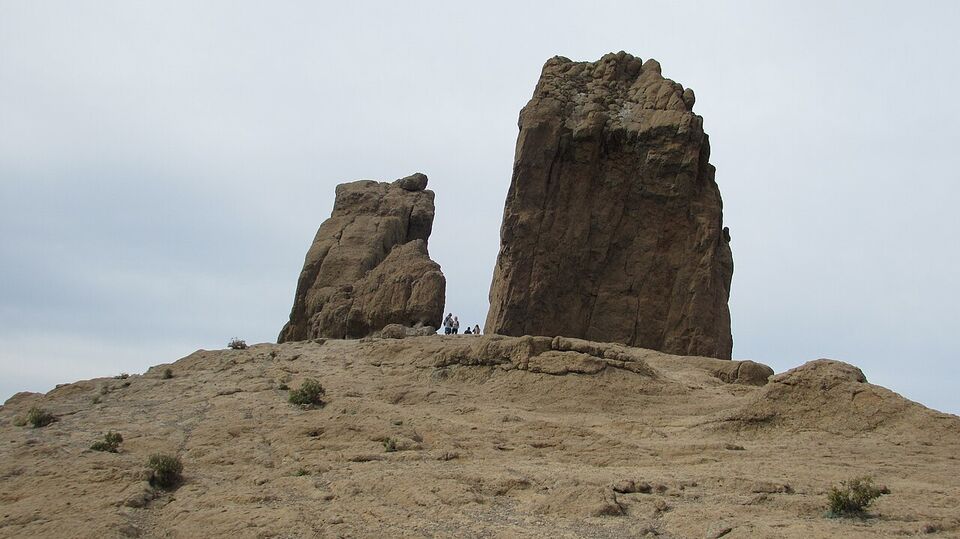
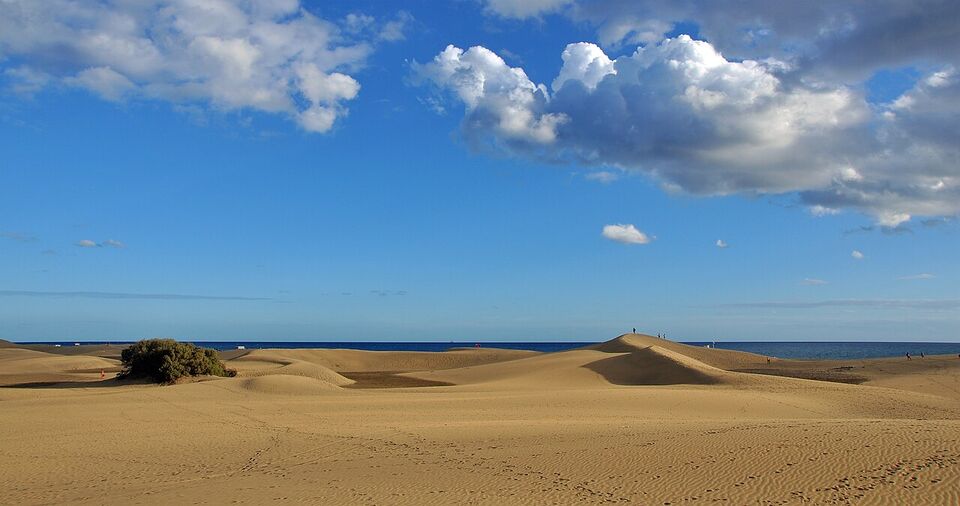
The south of the island has the Maspalomas Dunes, a nature reserve of rolling sand by the sea, and the resorts of Playa del Inglés and Maspalomas, the center of one of Europe's best-known LGBTQ+ resort scenes, with a big Pride festival in spring (see Spain by interest). Inland, the mountains rise to Roque Nublo, a rock pillar reached by a short hike, and to villages such as Tejeda. Risco Caído, a site of cave dwellings and sacred mountains of the islands' original people, became a UNESCO site in 2019.
Lanzarote
Lanzarote looks like another planet: black lava, red craters and white houses with green windows. Much of the look comes from César Manrique, the island's artist and architect, who persuaded authorities in the 1960s and 1970s to limit building heights and ban billboards. His works are now the main attractions: the cave auditorium and lagoon of Jameos del Agua, the clifftop Mirador del Río, the Jardín de Cactus and his house built into lava bubbles, now the César Manrique Foundation.
Timanfaya National Park, created by eruptions in the 1730s, is the island's essential sight. At the Montañas del Fuego (Mountains of Fire), the ground is hot enough just below the surface that staff pour water into a pipe to make a geyser, and a restaurant grills over volcanic heat. A coach takes visitors along the Ruta de los Volcanes. Entry is €30 (about $34) for adults, free under 7, from 9 a.m. to 3:45 p.m.; the visit takes about 90 minutes. Lines of cars can build up at the entrance by late morning, so arrive early.
Don't miss La Geria, the wine area where vines grow in hollows dug into volcanic ash and shielded by low stone walls. The local Malvasía Volcánica white is excellent; see Spanish wine.

Fuerteventura
Fuerteventura is the oldest island geologically, worn down to plains, dunes and some of the longest beaches in Europe. The Corralejo dunes in the north and the lagoons of Sotavento in the south are the classics. It is windy, which makes it a world center for windsurfing and kitesurfing; beginners should take lessons at a school in a sheltered lagoon.
It is also the quietest of the big four: a good choice for a beach week with a book. Try queso majorero, the island's goat cheese, often rubbed with paprika or gofio.
La Palma, La Gomera and El Hierro
La Palma is steep and green, with the vast Caldera de Taburiente National Park and the Roque de los Muchachos observatory on its rim. In 2021, the Tajogaite volcano erupted for 85 days, destroying more than 1,000 buildings and reshaping the west coast. The island has reopened to visitors and guided walks visit the new lava fields; tourism helps the recovery.
La Gomera, about 50 minutes by fast ferry from Los Cristianos on Tenerife, has the misty laurel forest of Garajonay National Park, a UNESCO site, and the silbo gomero, a whistled language once used to talk across ravines and still taught in schools. El Hierro, the smallest and most remote, is known for diving and its push toward running on renewable energy.
Getting there
United has flown nonstop from Newark to Tenerife South (TFS), typically on a Boeing 757 about three times a week, the only nonstop from the US. In recent years it has run in winter as well as summer, but seasonal schedules change, so check the current timetable before you plan around it. The flight takes about 7 to 8 hours eastbound.
Otherwise, connect via Madrid (about 2 hours 30 minutes to the islands), Barcelona or other European hubs. Iberia, Air Europa, Vueling and Binter fly from the mainland; Binter also links the islands with a number of mainland cities. Tenerife and Gran Canaria each have big international airports, and Tenerife has two: TFS in the south for most tourist flights, TFN in the north for many domestic and inter-island ones. See flights.
Insider tip
If you fly into Tenerife North and are staying in the south, the drive is about an hour on the motorway. Check which airport your flights use before you book a rental car or a hotel.
Island-hopping
Binter, the islands' airline, runs short turboprop flights between all the islands, often 25 to 45 minutes. Ferries are the alternative: Fred. Olsen Express and Naviera Armas run fast ferries and slower car ferries. Useful routes:
- Los Cristianos (Tenerife) to San Sebastián de La Gomera: about 50 minutes by fast ferry.
- Santa Cruz de Tenerife to Agaete (Gran Canaria): about 1 hour 20 minutes, with a connecting bus to Las Palmas.
- Playa Blanca (Lanzarote) to Corralejo (Fuerteventura): about 30 minutes.
Book ferries with a car well ahead at peak times. Check schedules at fredolsen.es and flights at bintercanarias.com.
Getting around
A rental car is the best way to see any of the islands, and rates are often low compared to the mainland. Roads are good but mountain roads are narrow, steep and full of hairpin bends. The main roads have speed limits of 120 km/h (75 mph) on motorways and 90 km/h (56 mph) on other roads. The islands' buses, called guaguas (a word also used in Cuba and Puerto Rico), are cheap and cover main routes, especially on Tenerife and Gran Canaria. See driving.
When to go
The islands have the mildest climate in Spain. Coastal highs average about 70°F (21°C) in January and 80°F (27°C) in August. The ocean is cooler than many Americans expect: about 66°F (19°C) in winter and 73°F (23°C) in late summer, more like Southern California than the Caribbean.
- Winter (November–March) is high season for Europeans escaping the cold. Prices rise around Christmas and Carnival.
- Spring and fall are pleasant and quieter.
- Summer is warm rather than hot at the coast, and busy with Spanish families in August.
The north side of each mountainous island is greener and cloudier; the south is sunnier and drier. A few times a year, the calima, dust blown from the Sahara, brings hazy skies, heat and poor air quality for a few days. Carnival in Santa Cruz de Tenerife and Las Palmas is the biggest event of the year, in February or early March; check the 2027 dates when they are announced. See festivals.
Food and drink
- Papas arrugadas: small potatoes boiled in very salty water until the skins wrinkle, served with mojo sauces, red (with peppers) and green (with cilantro).
- Gofio: toasted grain flour, a staple since before the Spanish conquest, stirred into stews, desserts and milk.
- Fresh fish, such as vieja (parrotfish), grilled simply.
- Local goat cheeses, bananas from the islands' plantations, rum and honey rum.
On Tenerife, look for guachinches, informal family wineries in the north that serve home-cooked food with their own wine for a few months a year. See Spanish food.
Costs, taxes and shopping
The Canaries are outside the EU's VAT area. Instead of Spain's 21% VAT, they have their own tax, the IGIC, with a general rate of 7%. Alcohol, tobacco and fuel are cheaper than on the mainland. There is no regional tourist tax, though the municipality of Mogán on Gran Canaria charges a small fee per night.
Save money
Because of the separate tax system, you cannot claim a mainland-style VAT refund on purchases here, and goods you send to the mainland may go through customs. Shop for big-ticket items elsewhere and enjoy the cheaper wine and rum here. See shopping.
Package hotels in the southern resorts can be very good value, especially outside winter. Expect $$ for most good resort hotels and $$$ to $$$$ for the luxury resorts of Costa Adeje.
Safety, sea and protests
The islands are generally very safe. The biggest danger is the Atlantic. Waves and currents are much stronger than in the Mediterranean, and drownings, many of them visitors, are a serious problem. Swim only at beaches with lifeguards, respect red flags, and do not walk on wave-washed rocks or natural pools in rough seas.
Hikers should check the weather and trail closures with the island government; mountain trails can close for wildfires or rockfalls. In 2024 and 2025, residents held big protests over the housing crisis and the pressure of mass tourism. They were peaceful. The State Department's Spain advisory is at Level 2 ("exercise increased caution") because of terrorism and civil unrest; avoid demonstrations, as it advises, and stay in licensed accommodation. See safety and health; in an emergency, call 112.
Practical tips
- Set your watch back an hour when you arrive from the mainland.
- Book the Teide summit trail on Tenerife ON as soon as slots open, 28 days ahead.
- Pack layers: the coast is warm, the mountains can be cold and windy.
- Sun protection: the UV index is high all year, even in winter.
- Tap water is safe in most places but often desalinated and tastes flat; many locals drink bottled water.
- Plugs and power are the same as the mainland: Type C/F, 230 V. See staying connected.
- Combining the islands with Madrid or Andalusia is easy by plane. See planning your trip.
Add it to a route in the trip builder, or ask us to plan the hotels, trains and guides for you.