Should you add another country?
Spain shares borders with Portugal, France and Andorra, sits 9 miles (14 km) from Africa across the Strait of Gibraltar, and wraps around the British territory of Gibraltar. Americans crossing an ocean naturally want to tick off two or three countries, and Spain makes it tempting.
The honest advice: on a first trip of ten days or less, Spain alone is plenty, and every border crossing eats most of a day once you add checkout, transfers and the journey itself. With two weeks or more, a second country fits comfortably. Some pairings barely feel like extra travel: San Sebastián and the French Basque coast, Galicia and Porto, Seville and the Algarve, Tarifa and Tangier.
Portugal and France are in the Schengen area with Spain, so there are no passport checks between them, but every day counts toward one shared 90-day limit (see the end of this page and entry rules). Morocco is outside Schengen and the EU, so crossing means a full passport check both ways. For planning the Spanish part of the trip, start with plan your trip.
Trains to France
Barcelona to Paris by TGV
France's railway, SNCF, runs direct TGV trains between Barcelona Sants and Paris Gare de Lyon through the Perthus tunnel under the Pyrenees, stopping at Girona, Figueres, Perpignan, Narbonne and other cities in southern France. The trip takes about 6 hours 30 minutes, and there are only a few direct trains a day, so they sell out in summer and around holidays. Book on SNCF Connect or through Trainline or Rail Europe.
Renfe had planned its own Barcelona to Paris service, but in April 2026 it suspended the project, citing French approval delays, and it has also dropped its Barcelona to Toulouse route. Renfe says Paris may return when conditions allow. For now, SNCF is the only direct option.
Barcelona to Marseille, Lyon and Provence
Renfe's AVE trains run daily from Barcelona across the border to Lyon Part-Dieu, and to Marseille via Montpellier, Nîmes, Avignon and Aix-en-Provence. One daily train runs all the way from Madrid Atocha to Marseille via Zaragoza and Barcelona, a journey of a little over 8 hours. Advance fares from Barcelona to French cities start around €25 (about $28) in standard class and €45 (about $50) in first; they are limited and sell out early. Booking usually opens about four months ahead, sometimes less around the December timetable change.
Renfe's website has no booking fee but can reject some US cards; Trainline and Rail Europe show both Renfe and SNCF trains for a small fee. Seat reservations are compulsory and included in the ticket.
Insider tip
Girona and Figueres (for the Dalí Theatre-Museum) are on the high-speed line to France, so you can stop off on the way. Perpignan and the fishing village of Collioure, which Matisse painted, make an easy French night between Barcelona and Provence. See Girona and the Costa Brava.
The Basque border: San Sebastián to Hendaye
From San Sebastián, the Euskotren commuter train (locals call it the Topo, the mole) runs every 15 to 30 minutes to Hendaye, just over the French border, in about 35 minutes. At Hendaye station you can pick up TGV trains to Bordeaux and Paris, or regional trains to Saint-Jean-de-Luz and Biarritz on the French Basque coast. Buses also run from San Sebastián and Bilbao to Biarritz and Bayonne. See the Basque Country.
Through the Pyrenees
Two slower routes are scenic. Barcelona's R3 regional line climbs through the Catalan Pyrenees to Puigcerdà and the French border station of Latour-de-Carol, where you can connect to French trains toward Toulouse and to the night train to Paris. On the coast, regional trains run north from Barcelona and Girona to the border at Portbou, where you change to French trains at Cerbère.
Watch out
Strikes are common in both countries; a French grève or a Spanish huelga can cancel international trains with short notice. If you have a flight home from Paris or Madrid, give yourself a day of buffer.
Is the train better than flying to France?
From Barcelona to southern France, the train wins easily: it is direct, scenic and city center to city center. To Paris it is close: 6 hours 30 minutes on the TGV versus about 1 hour 45 minutes in the air plus airport time on both ends. From Madrid, fly to Paris (about 2 hours), unless you want to stop in Barcelona or the south of France on the way. Air France, Iberia, Vueling and several budget airlines fly the route many times a day.
Spain and Portugal
Portugal is Spain's natural partner, and Lisbon, Porto and the Algarve pair beautifully with Madrid, Galicia and Andalusia. The catch is that rail links between the two countries are poor and have been for years. Remember that Portugal is one hour behind mainland Spain.
Madrid to Lisbon
There has been no direct train since the Lusitania night train was suspended in 2020 and then discontinued. The rail route today needs three trains (Madrid to Badajoz, Badajoz to Entroncamento in Portugal, then on to Lisbon) and takes roughly 9 to 12 hours, with two separate bookings. It suits rail fans with a day to spare. Spain and Portugal plan a high-speed line, but a faster direct service is not expected before about 2030.
Most people fly. TAP Air Portugal, Iberia and budget airlines link Madrid and Lisbon many times a day in about 1 hour 15 minutes, and the airport is close to central Lisbon. Overnight and daytime buses also run between the two cities in about 8 to 9 hours with operators such as ALSA and FlixBus.
Galicia to Porto
The best rail link is in the northwest. The Celta train runs twice daily between Vigo Guixar and Porto Campanhã in about 2 hours 30 minutes, with a regular fare of about €17 (about $19). From Campanhã, a free connecting train takes you to Porto's São Bento station in the old town. Between April 2026 and April 2027, buses replace trains between Vigo and the border at Valença because of engineering work, so check the current arrangements. From Santiago de Compostela, take the train to Vigo first, or a direct bus to Porto. See Galicia.
Andalusia to the Algarve and Lisbon
From Seville, buses reach Faro and the Algarve beach towns in about 3 hours, and Lisbon in about 7. There is no train across this border. Driving is the most flexible option: the A-49 from Seville becomes Portugal's A22 across the Guadiana River bridge at Ayamonte. Portugal's highway tolls are collected electronically, so ask your rental company how it handles them.
Save money
Rental companies charge steep fees to drop a Spanish car in Portugal. It is often cheaper to return the car in Spain (Seville or Huelva), take a bus or flight across, and rent again in Portugal. See driving in Spain.
Spain and Morocco
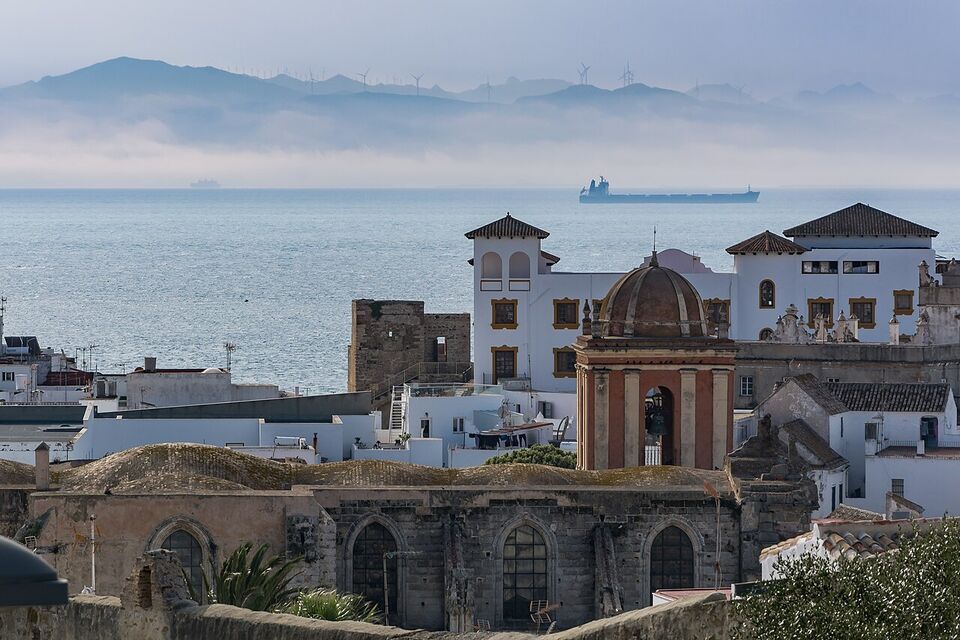
Africa is close enough to see from Tarifa on a clear day. Ferries cross the Strait of Gibraltar in about an hour, and a day trip to Tangier, or a few nights in Tangier, Chefchaouen, Fez or Marrakech, is one of the most memorable things you can add to an Andalusia trip.
Ferries across the Strait
| Route | Crossing | Good for |
|---|---|---|
| Tarifa to Tangier Ville | About 1 hr by fast ferry | Foot passengers and day trips; lands in Tangier's city port |
| Algeciras to Tangier Med | About 1 hr 30 min | Cars and trucks; Tangier Med port is about 25 miles (40 km) from Tangier city |
| Algeciras to Ceuta | About 1 hr | Ceuta is a Spanish city on the African coast; the land border into Morocco can be slow |
| Málaga or Almería to Melilla | Several hours, some overnight | The other Spanish city in North Africa |
The main operators are FRS, Baleària and Naviera Armas. Tickets are sold online and at the ports; summer weekends and the August period when Moroccans living in Europe travel home are the busiest. Strong easterly winds (the levante) sometimes cancel sailings from Tarifa, so do not schedule a Tangier crossing for the day before your flight home. If you plan to visit Ceuta or Melilla, check the State Department advisory for any separate wording on them before you go.
Insider tip
Ferry companies in Tarifa sell day trips to Tangier that bundle the crossing, a guide and lunch. They are easy but rushed. If you have the time, stay a night or two: the medina is calmer in the evening, and Tangier's high-speed Al Boraq train reaches Rabat and Casablanca in a few hours.
What Americans need for Morocco
- Entry: US citizens do not need a visa for tourist stays of up to 90 days. Check the passport validity requirement on the State Department's Morocco page; many airlines and ferry lines expect six months of validity.
- Passport checks: leaving Spain means leaving Schengen, so you go through exit control (and the Entry/Exit System) and then Moroccan immigration. On the Tarifa ferry, Moroccan police often stamp passports on board, so look for the line as soon as you sail.
- Money: Morocco uses the dirham, which you can only buy inside the country. ATMs are easy to find in Tangier; cards work in hotels and bigger restaurants, cash elsewhere.
- Time: Morocco keeps the same clock time as mainland Spain in winter and runs one hour behind in summer, but it sets its clocks back an hour during Ramadan (roughly February to early March in 2027), so check the time difference for your dates.
- Safety: read the State Department's current Morocco advisory before you go, and expect persistent touts and unofficial guides in the medinas.
Flying to Morocco
For Marrakech or Fez, fly. Royal Air Maroc, Iberia, Vueling and budget airlines link Madrid, Barcelona, Málaga and Seville with Marrakech, Fez, Tangier and Casablanca, often in under 2 hours from Andalusia. Spanish rental cars generally cannot be taken to Morocco.
Gibraltar
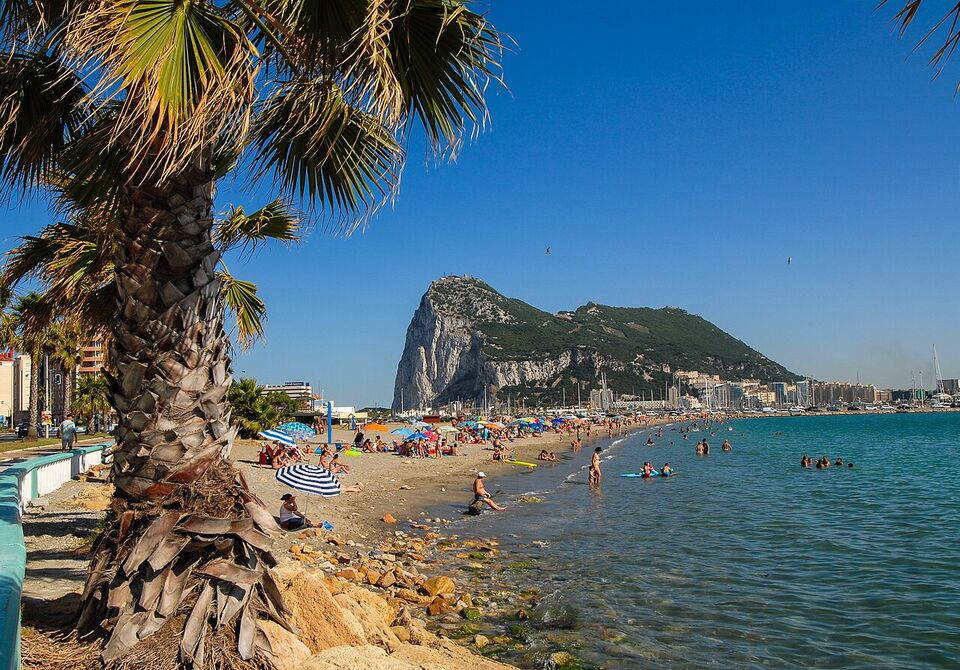
Gibraltar, a British territory of about 34,000 people on a limestone rock at the tip of Andalusia, has been a sore point between Spain and the UK for three centuries. For decades, the land border at La Línea de la Concepción meant passport checks and, at times, hours of queues.
That changed in 2026. Under a treaty between the EU and the UK, the border fence came down at midnight on July 15, 2026, ending routine checks on the land crossing. Instead, arrivals from outside the Schengen area go through Gibraltar and Schengen entry checks at Gibraltar's airport and port. Gibraltar itself stays British and outside Schengen, and customs rules still apply at the land crossing, so the tobacco and alcohol limits remain.
For Americans, that means you walk in from La Línea with your passport and no routine passport check; days in Gibraltar do not technically count toward your 90, but with no record at the land crossing, plan as if they do. Flying into Gibraltar now means a Schengen entry check, including the Entry/Exit System, on arrival. Details are still settling in, so check the Gibraltar government's current guidance before you go.
Visiting Gibraltar
- Getting there: buses run from Málaga, Seville, Algeciras and Tarifa to La Línea, a short walk from the old border. Walking across is easiest; driving into town usually means traffic and limited parking.
- What to see: the Upper Rock Nature Reserve with its Barbary macaques, the cable car, St. Michael's Cave, the Great Siege Tunnels and the views across the Strait to Morocco. The runway, which the main road crosses, is a sight in itself.
- Money and language: English is the official language, and the Gibraltar pound trades at par with sterling. Euros are accepted in many places but at a poor rate; pay by card.
- Time: allow a half day for the Rock, a full day with lunch and Main Street.
Watch out
The macaques are wild animals and will grab food, bags and sunglasses. Do not feed or touch them; feeding them is illegal and carries a fine.
Andorra and the Pyrenees
The tiny mountain country of Andorra, between Spain and France, is about 3 hours by bus from Barcelona and its airport. It draws skiers in winter and hikers and duty-free shoppers the rest of the year. Andorra uses the euro but is not in the EU or Schengen, and you reach it only through Spain or France, so you must be eligible to be in Schengen to get there. Expect customs checks on the way back into Spain, since Andorra's low taxes make tobacco, alcohol and electronics cheaper.
Ferries to Italy and the UK
Long ferries are a slow but relaxing way to continue a trip. Overnight ships sail from Barcelona to Civitavecchia (for Rome), Genoa and Porto Torres in Sardinia, taking roughly 12 to 20 hours depending on the route, with Grimaldi and GNV the main operators. From the north coast, Brittany Ferries runs long overnight sailings from Bilbao and Santander to Portsmouth and Plymouth in England. Book a cabin for overnight crossings. See our Italy and United Kingdom guides for what comes next.
Flying around Europe from Spain
Madrid, Barcelona, Málaga, Valencia, Seville and Palma have dense European networks. Iberia, Iberia Express, Vueling, Air Europa, Ryanair, easyJet and Volotea fly to almost every major city. Budget fares look tempting, but the low price usually covers only a small under-seat bag; a full carry-on and checked bag can double the price. Compare the total fare against the train for anything under about 4 hours on rails.
An open-jaw transatlantic ticket helps here: fly into Lisbon and home from Barcelona, or into Madrid and home from Paris, and you avoid backtracking. See flights.
Sample combinations
- Barcelona and the south of France
10–12 days
Five nights in Barcelona with a day in Girona, then the AVE to Montpellier or Avignon for three nights in Provence, and fly home from Marseille or back from Barcelona. See Barcelona and our France guide.
- Basque Country on both sides
7–8 days
Bilbao and the Guggenheim, four nights in San Sebastián for pintxos, and a day or two in Saint-Jean-de-Luz and Biarritz by the Topo train. Fly into Bilbao in summer or into Madrid year-round.
- Madrid, Andalusia and Lisbon
14 days
Madrid, then the AVE to Córdoba and Seville (high-speed trains between Madrid and Andalusia were suspended after the October 28, 2026 Urda collision, with Renfe not selling tickets before December 13; check before you book, or fly to Seville), a car or bus to the Algarve, and on to Lisbon to fly home. See Seville and Andalusia.
- Galicia and Porto
7–9 days
Santiago de Compostela, the Rías Baixas around Vigo, and the Celta train (or replacement bus) to Porto. Fits well after walking the end of the Camino.
- Andalusia and northern Morocco
10–12 days
Granada, Seville and Cádiz, then Tarifa and the ferry to Tangier for two nights, with an optional trip to Chefchaouen. Return via Tarifa and finish in Málaga. See Málaga.
The Schengen clock
Spain, Portugal, France, Italy and 25 other countries make up the Schengen area. As an American, you can spend up to 90 days in any 180-day period across all of them combined. Days in Morocco, the UK, Ireland or other non-Schengen countries do not count, and leaving Schengen pauses the clock.
The EU's Entry/Exit System now records your entries and exits electronically, with fingerprints and a photo taken on your first crossing, so the count is exact and overstays are flagged automatically. ETIAS, the travel authorization Americans will eventually need, is not yet in operation. The EU offers an online short-stay calculator for checking your dates. Full details are on our entry rules page, the ETIAS guide and, for longer stays, long stays in Spain.
- Count every day in any Schengen country, including arrival and departure days.
- Keep boarding passes and ferry tickets in case you need to show when you left and returned.
- Carry your passport on every border crossing, including the ferry to Morocco and the trip into Gibraltar or Andorra.
- Check the State Department's advisory for every country you add, as well as Spain.
Add it to a route in the trip builder, or ask us to plan the hotels, trains and guides for you.