
How Spain eats
Spanish food is regional first and national second. A Basque cook and an Andalusian cook share olive oil, bread and a love of pork, and not much else: the north eats beans, beef, cider and butter-soft fish; Valencia eats rice; the south eats fried fish, cold soups and the best ham in the world. Every region, and many towns, will tell you their version is the right one.
What unites the country is the rhythm. Spaniards eat late, eat out often and eat standing at a bar as happily as sitting at a table. Food is social: you share plates, you move between bars, and a lunch with friends on a Sunday can run until 6 p.m. The best way to eat well here is to adjust your clock and follow the locals.
Meal times
| Meal | When | What it looks like |
|---|---|---|
| Desayuno (breakfast) | 7:30–10 am | Light: coffee and toast with tomato and olive oil, a pastry, or churros |
| Almuerzo or tentempié (mid-morning snack) | 10:30 am–noon | A slice of potato omelet, a small sandwich, a coffee. In Valencia, the almuerzo is a hearty sandwich and a drink |
| Aperitivo | 1–2 pm | A vermouth or caña (small draft beer) with olives or chips |
| Comida (lunch) | 2–4 pm | The main meal: two or three courses, often the menú del día |
| Merienda (afternoon snack) | 5:30–7 pm | Coffee and something sweet, or a sandwich for the kids |
| Tapeo (tapas crawl) | 8–10 pm | A drink and a bite in two or three bars |
| Cena (dinner) | 9–11 pm | Lighter than lunch, or a long tapas dinner |
Restaurant kitchens usually close between lunch and dinner, roughly 4 to 8:30 p.m. If you are hungry at 6, go to a bar, a market or a café, which serve all day. In big cities a growing number of places advertise cocina non-stop or horario ininterrumpido (kitchen open all day). See Etiquette for more on Spanish hours.
Different from home
An empty dining room at 8 p.m. says nothing about the cooking. You are simply early. Book a table for 9 or 9:30 and it will be full around you by 10. In Madrid and the south, dinner at 10:30 on a summer Saturday is normal, and you will see families with small children out after midnight.
Sundays, Mondays and August
Many restaurants close on Sunday evening and on Monday, and family-run places in Madrid, Barcelona and inland cities close for two to four weeks in August, when owners head to the coast. Check before you walk across town. Markets close on Sundays (and some on Monday too), and supermarkets close on Sundays in most regions, Madrid being the big exception.
The menú del día
The menú del día (menu of the day) is Spain's great everyday deal: a weekday set lunch with a first course, a main, dessert or coffee, bread and a drink (wine, beer or water) for one price. In 2026 it typically costs €13–20 (about $15–22), a few euros more in central Barcelona, Madrid and San Sebastián, and less in small towns. It is posted on a chalkboard outside the door or on a printed sheet.
- First courses (primeros): salad, soup, lentils or chickpea stew, gazpacho in summer, pasta or rice.
- Mains (segundos): grilled or stewed meat, fish of the day, chicken. Simple, home-style cooking.
- Dessert (postre): flan, rice pudding, fruit, ice cream or coffee instead.
- The menú is usually served only at lunch on weekdays. Weekend versions exist but cost more.
- Some upscale restaurants offer a menú ejecutivo or menú degustación (tasting menu) at lunch, which is the cheapest way into a high-end kitchen.
Save money
Make lunch your big meal and dinner a few tapas. A menú del día at 2 p.m. plus two or three tapas and a glass of wine at 9 p.m. costs much less than a full dinner, and it is how many Spaniards eat. See Money for daily budgets.
Tapas, raciones and pintxos
A tapa is a small plate eaten with a drink. It can be a few olives, a slice of potato omelet (tortilla de patatas), fried squid, meatballs or a little stew. Tapas are a way of eating: you stand or perch at the bar, order a drink and a bite or two, and move on.
Sizes and how to order
- Tapa: a small portion, a few bites.
- Media ración: a half portion, enough for two to share.
- Ración: a full plate for sharing among three or four. Three or four raciones make a dinner for a group.
Many bars list food on a chalkboard and some serve tapas only at the bar, not at tables. On a terrace, prices are often higher than at the bar. Order in rounds: a drink and one or two things, then more if you want.
Free tapas
In Granada, Jaén, Almería and León, a free tapa still comes with every drink you order, and it gets bigger as the evening goes on. In Granada, a round of three or four drinks with their tapas can make a light dinner for the price of the drinks. Elsewhere, you may get a few olives or chips with your drink, but tapas are on the bill.
Pintxos in the Basque Country
In San Sebastián, Bilbao and Vitoria, tapas are pintxos: small bites, often on a slice of bread and held together with a toothpick (pintxo comes from the word for a spike). The cold ones sit on the bar; the best ones are often the hot pintxos cooked to order from the chalkboard. The classic is the Gilda: an anchovy, an olive and a pickled green pepper on a toothpick.
- Squeeze in at the bar and ask for a plate.
- Take one or two cold pintxos, and order a hot one from the board.
- Order a drink: a zurito (a very small beer), a glass of txakoli (a fizzy local white) or a crianza.
- Keep track of what you had. When you are done, tell the bartender, who will add it up on trust.
- Move on to the next bar. One or two pintxos per bar is the custom.
See the Basque Country for neighborhoods and bar-crawl routes.
Insider tip
The busiest tapas and pintxo bars clear fast. Do not wait for a waiter to notice you. Make eye contact, say perdona (excuse me) and order clearly. A little assertiveness at a crowded Spanish bar is normal and expected.
Region by region
Madrid and the two Castiles
Madrid's signature dish is cocido madrileño, a chickpea stew with meats and vegetables served in courses: first the broth with noodles, then the chickpeas and vegetables, then the meats. Look also for callos (tripe stew), huevos rotos (fried eggs over potatoes), patatas bravas with spicy sauce and the fried-squid sandwich (bocadillo de calamares) around the Plaza Mayor. In Castile and León, roast meats rule: cochinillo (suckling pig) in Segovia, lechazo (milk-fed lamb) in Sepúlveda and Aranda de Duero, morcilla (blood sausage) from Burgos and cecina (cured beef) from León. La Mancha gives you Manchego cheese, pisto (a vegetable stew) and saffron. See Madrid food and Castile.
Andalusia
The south is the home of cold soups: gazpacho; salmorejo, a thicker tomato cream from Córdoba topped with egg and ham; and ajoblanco, a white almond and garlic soup from Málaga. Fried fish (pescaíto frito) is an art in Cádiz and Málaga, along with sardine skewers grilled over driftwood on the beach (espetos) and shrimp fritters (tortillitas de camarones). Córdoba has rabo de toro (oxtail stew) and flamenquín; the coast near Barbate and Zahara has bluefin tuna caught in spring. The province of Huelva produces some of the finest jamón ibérico. See Seville, Córdoba and Andalusia.
Valencia and the east
Paella was born in the rice fields around Valencia, and the original paella valenciana has chicken, rabbit, flat green beans and white beans, sometimes snails, and no seafood. Valencia also makes arroz a banda (rice cooked in fish stock), arroz negro (with squid ink), fideuà (the same idea with short noodles) and all i pebre (eel stew from the Albufera lagoon). Drink horchata (orxata), a cold milky drink of tiger nuts, with fartons, soft sweet pastries for dunking. Paella is a lunch dish; locals do not eat it at night. See Valencia.
Watch out
Bright yellow paella on a photo menu outside a restaurant on Las Ramblas or the Plaza Mayor is almost always reheated and colored. Good paella is cooked to order, takes 20 to 30 minutes, is usually for a minimum of two people and arrives thin, in the pan, with a crisp layer on the bottom (socarrat).
Catalonia
Catalan cooking mixes sea and mountain (mar i muntanya). The everyday staple is pa amb tomàquet, bread rubbed with tomato, olive oil and salt. Look for escalivada (smoky roasted peppers and eggplant), esqueixada (salt-cod salad), botifarra sausage with white beans, suquet (fish stew) on the Costa Brava and crema catalana, the local cousin of crème brûlée. From about January to March, Catalans hold calçotades: grilled spring onions, dipped in romesco sauce and eaten in long messy feasts in the countryside around Valls. See Barcelona and the Costa Brava.
The Basque Country and Navarra
Spain's most celebrated food region has more Michelin stars per person than almost anywhere, and an even better everyday scene. Beyond pintxos, look for txuleta (a thick rib steak from older cows, grilled over coals), bacalao al pil-pil (salt cod in an emulsion of its own gelatin and olive oil), kokotxas (hake cheeks), txangurro (spider crab) and Idiazabal sheep's cheese. Navarra and La Rioja are vegetable country: white asparagus, artichokes from Tudela, piquillo peppers from Lodosa and menestra (spring vegetable stew). See Rioja and Navarra.
Galicia, Asturias and Cantabria
Galicia is seafood: pulpo á feira (octopus boiled in copper pots, cut with scissors, dressed with paprika, salt and olive oil on a wooden plate), percebes (goose barnacles), razor clams, scallops, empanada (a savory pie) and Tetilla cheese. Pimientos de Padrón are small fried green peppers, most mild and an occasional one fiery. Asturias makes fabada (white beans with chorizo, blood sausage and pork), cachopo (two veal fillets stuffed with ham and cheese, breaded and fried) and Cabrales, a strong blue cheese aged in mountain caves; it washes them down with cider. Cantabria is known for Santoña anchovies. See Galicia and Northern Spain.
The islands
Mallorca has sobrassada (a soft, spreadable paprika sausage), ensaïmada (a spiral pastry dusted with sugar) and tumbet (layered vegetables); Menorca has Mahón cheese and a famous, expensive lobster stew (caldereta de langosta). In the Canary Islands, eat papas arrugadas (small potatoes boiled in salty water until wrinkled) with red and green mojo sauces, fresh fish, goat's cheese and gofio, toasted grain flour. On Tenerife, guachinches are informal, family-run spots in the hills that serve homemade wine and simple food. See the Balearics and the Canary Islands.


Jamón: how to read the label
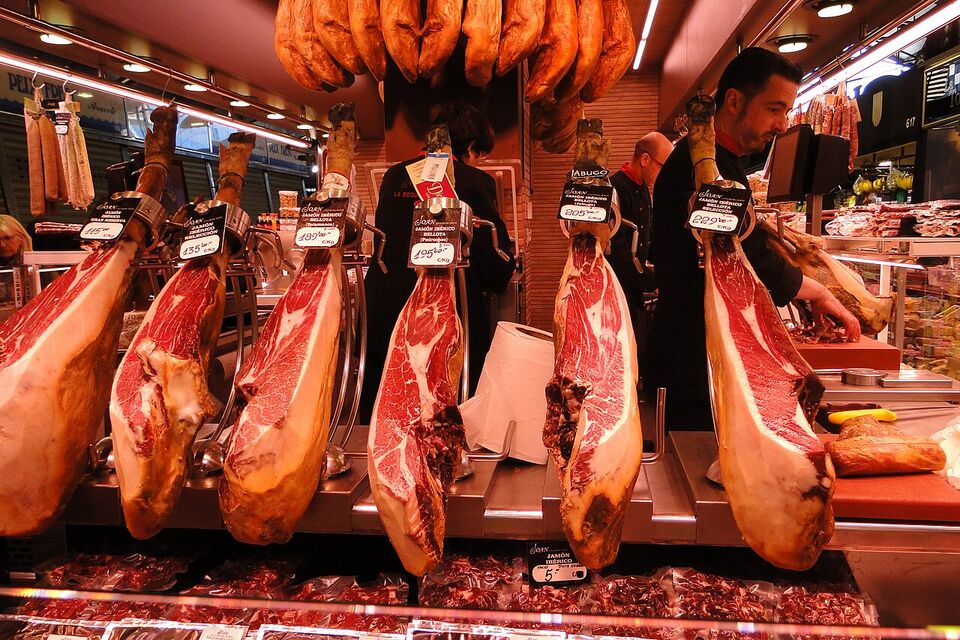
Spanish cured ham comes in two broad families. Jamón serrano is made from white pigs and is the everyday ham of sandwiches and bar counters. Jamón ibérico comes from the native black Iberian pig, is cured much longer and costs far more. Since 2014, ibérico hams carry a colored tag by law:
| Tag | What it means |
|---|---|
| Black | 100% ibérico de bellota: purebred Iberian pig, fattened on acorns in the open oak woodlands (dehesa). The top grade. |
| Red | Ibérico de bellota: part-Iberian pig, acorn-fed. |
| Green | Ibérico de cebo de campo: free-range, fed on grain and pasture. |
| White | Ibérico de cebo: raised on farms and fed grain. |
Good ham is sliced by hand, paper-thin, at room temperature, and the fat should glisten. A plate of hand-cut bellota ham is one of the most expensive tapas on any menu, priced by the plate or by weight, so check before ordering. Paleta is the shoulder: similar flavor, smaller and cheaper.
Food markets
Every Spanish town has a covered market (mercado), and the best ones mix produce stalls with bars serving lunch. Go in the morning, when locals shop, and remember that most close on Sundays.
La Boqueria
The most famous market in Spain, and the most crowded. Go early on a weekday and head to the counter bars at the back. Santa Caterina, in El Born, and Sant Antoni are calmer neighborhood alternatives.
Mercado de San Miguel
A wrought-iron market hall turned into a gourmet tapas hall, open from 10 a.m. until midnight or later. Polished and pricey; for a real neighborhood market, try San Fernando in Lavapiés or Antón Martín.
Mercado Central
A huge modernista market hall of iron, glass and tiles, with more than enough rice, vegetables and seafood to understand why paella was born here.
Mercado de Triana
Built over the ruins of a castle of the Inquisition, with tapas counters among the fish stalls.
La Bretxa and San Martín
Where the city's cooks buy fish and vegetables in the morning, before the pintxo bars open.
Mercado de Abastos
A granite market where you can buy seafood at a stall and have it cooked at a bar in the market.
Hours change by season and holiday, so check the market's own site before a special trip.
Coffee, churros and sweets
Spanish coffee is espresso-based and cheap, and you order it by name:
- Café solo: an espresso.
- Cortado: espresso with a splash of hot milk.
- Café con leche: half coffee, half hot milk, the breakfast standard.
- Café con hielo: a solo with a glass of ice; you pour it over yourself. The Spanish iced coffee.
- Bombón: espresso over sweet condensed milk, popular in Valencia.
- Carajillo: coffee with a shot of brandy or rum, an after-lunch habit.
Churros are fried dough sticks dipped in thick hot chocolate; porras are their fatter cousins. Madrileños eat them for breakfast and at dawn after a night out. Other sweets to try: turrón (almond nougat, a Christmas treat from Alicante and Jijona), tarta de Santiago (almond cake from Galicia), torrijas (Spanish French toast, made for Holy Week), polvorones (crumbly Christmas shortbread) and the Basque burnt cheesecake that San Sebastián made famous.
Allergies, gluten-free and vegetarian
EU law requires restaurants to tell you which of 14 major allergens are in each dish, including gluten, nuts, peanuts, shellfish, milk, eggs, fish and soy. Ask for the allergen chart (la carta de alérgenos); most places have one.
- Gluten-free: Spain is one of the easier countries in Europe for celiacs. Say soy celíaco (or celíaca for a woman) and look for sin gluten on menus. The Spanish celiac federation, FACE, runs a network of trained restaurants and an app listing them, plus advice in English for visitors. Watch for flour in fried fish and in stews.
- Vegetarian: say soy vegetariano (or vegetariana) and no como carne ni pescado (I do not eat meat or fish). Ham turns up in vegetable dishes, tuna in salads and meat stock in bean and lentil stews, so ask. Safe bets: tortilla de patatas, pimientos de Padrón, patatas bravas, pisto, escalivada, gazpacho and salmorejo (ask for it without the ham).
- Vegan: easy in Madrid, Barcelona and Valencia, which have many vegan restaurants; harder in small towns and the interior, where you will lean on salads, vegetables and bread.
- Nuts: frutos secos (tree nuts) and cacahuetes (peanuts). Almonds are common in sauces such as romesco and in desserts.
- Shellfish: marisco. It turns up in rice dishes and in fish stock.
Carry a card in Spanish that explains a serious allergy, and see Health for pharmacies and emergency care. For more phrases, see Spanish for travelers.
The bill, water and tipping
- Ask for the bill. A waiter will never bring it unasked, because rushing you would be rude. Say la cuenta, por favor. At a bar, you usually pay at the end, not per round.
- Tax is included. Menu prices include IVA (Spain's VAT), which is 10% in restaurants.
- Bread is often brought automatically and may carry a small charge, which should be on the menu. If you do not want it, say so when it arrives.
- Terraces cost more. Many bars charge a little more for the same drink at an outside table.
- Tap water is free. Since 2022, Spanish law has required bars and restaurants to offer tap water free of charge. Ask for agua del grifo. It is safe almost everywhere; in Barcelona it tastes of chlorine, which is why locals buy bottled.
- Tipping is small. Round up or leave the coins at a bar or for a menú del día, and 5–10% for good service at a sit-down dinner. Nobody expects 20%. If the card machine asks about a tip, it is fine to choose none and leave cash. See Etiquette.
Different from home
Free refills do not exist, iced water is not served automatically, and portions are smaller than in the US. Doggy bags are becoming more common, and a 2025 national law on food waste pushes restaurants to offer you a container for leftovers at no charge. Ask for un táper (a takeout box).
Food tours, classes and splurges
Food tours are an easy way into the tapas scene in Madrid, Seville and San Sebastián, especially if you do not speak Spanish. A good guide takes you to four or five bars in a neighborhood and explains what to order. Book small groups through the city tourism offices or established operators.
Cooking classes: paella in Valencia, often with a market visit; tapas in Seville and Madrid; pintxos in San Sebastián.
Fine dining: Spain has one of the world's great high-end restaurant scenes, with three-Michelin-star kitchens in the Basque Country, Catalonia, Madrid, Valencia and Andalusia. Tasting menus at the top places cost several hundred euros per person before wine, and reservations open months ahead. A lunch tasting menu at a one-star restaurant is a gentler way in.
Basque gastronomic societies (txokos) are private cooking clubs where members cook for friends. You can go only as a member's guest, so treat an invitation as an honor.
Insider tip
For a cheap, excellent picnic, shop at a market or a supermarket like Mercadona: bread, a wedge of Manchego, a tin of good sardines or tuna belly, olives, tomatoes and a bottle of local wine. Spanish canned seafood (conservas) is a delicacy in its own right, sold in beautiful tins. See Wine for what to drink with it.
What food you can bring home
Many of Spain's best foods travel well, and the US allows most of them if you declare them at customs:
- Usually fine: olive oil, saffron, smoked paprika (pimentón de la Vera), turrón, canned seafood, packaged sweets, hard cheeses such as Manchego and Mahón, and wine within the alcohol allowance.
- Not allowed: meat products, including jamón, chorizo, salchichón, sobrassada and lomo, even vacuum-packed from a duty-free shop. US agricultural rules bar pork products from Spain, and customs officers confiscate them and can fine you.
- Always declare food on your customs form or in the CBP app. Declared items that are not allowed are simply taken; undeclared ones can cost you a penalty.
See Shopping and bringing things home for details and US customs limits.
Add it to a route in the trip builder, or ask us to plan the hotels, trains and guides for you.