Overview
Madrid sits in the middle of Castile, and within an hour of the city are some of the most remarkable old towns in Europe. Toledo was the capital of Visigothic and medieval Spain and the home of El Greco. Segovia has a Roman aqueduct running through its center and a fairy-tale castle on a cliff. Ávila is wrapped in complete medieval walls. Philip II's monastery-palace at El Escorial was the nerve center of a world empire. All seven of the main towns on this page are UNESCO World Heritage Sites.
Fast trains make all of them easy without a car. The trick is choosing well: two or three day trips is plenty for most visitors, and one of them should probably be an overnight. This page covers how to get there, what to see, what it costs and what goes wrong. For Madrid itself, see Madrid and Madrid sights; for longer trips into Castile, see Salamanca and Castile.
Different from home
Spanish high-speed trains have airport-style bag scanners, assigned seats and boarding that closes a couple of minutes before departure. Commuter trains (Cercanías) are more like a US subway: no seat reservation, tap or buy a ticket, and go. Know which kind you are taking.
Which day trip to choose
| Destination | From Madrid | Travel time | Best for | Closed or limited |
|---|---|---|---|---|
| Toledo | Avant or AVE from Atocha | About 33 min | First-timers, history, El Greco, views | Cathedral opens only at 2 pm on Sundays |
| Segovia | AVE or Avant from Chamartín to Segovia-Guiomar, then bus | About 27 min plus 15–20 min bus | The aqueduct, the Alcázar, roast suckling pig | Most sights open daily |
| Ávila | Regional train from Chamartín | About 1 hr 30 min–2 hr | Walls, Saint Teresa, quiet streets | Walls closed Mondays in winter |
| El Escorial | Bus 664 from Moncloa, or Cercanías commuter train | About 50 min–1 hr | Habsburg history, art, mountain air | Monastery closed Mondays |
| Alcalá de Henares | Cercanías C2 or C7 from Atocha | About 35–40 min | Cervantes, the old university, free tapas | Cervantes house closed Mondays |
| Aranjuez | Cercanías C3 from Atocha | About 45 min | Royal palace and gardens, spring strawberries | Palace closed Mondays |
| Cuenca | AVE from Atocha to Cuenca-Fernando Zóbel, then bus | About 55 min plus 15 min bus | Hanging houses, gorges, abstract art | Museums mostly closed Mondays |
If you only have one day, choose Toledo. With two, add Segovia. With three, choose between El Escorial (history and art), Ávila (walls and atmosphere) and Cuenca (scenery).
Trains, buses and tickets
State operator Renfe runs all the train routes on this page. Its private competitors, Iryo and Ouigo, focus on the long-distance lines to Barcelona, Valencia and Andalusia, so for these short trips you will book with Renfe. See getting around Spain for how the operators compare.
- Avant is Renfe's medium-distance high-speed service, priced for commuters, on routes such as Madrid–Toledo and Madrid–Segovia. Some AVE long-distance trains also stop at Segovia and Cuenca and cost more.
- Fares vary with the train and how early you book. On Toledo and Segovia, expect roughly €10–30 (about $11–34) each way. Renfe does not publish fixed fare tables, so check the app.
- Book on the Renfe website or app. Book a few days ahead for weekends, holidays and Easter week, when morning trains to Toledo and Segovia sell out. Buy the return at the same time; the last trains back fill up too.
- Cercanías commuter trains (C2 and C7 to Alcalá, C3 to Aranjuez, and the El Escorial line; check the current Cercanías map) cost a few euros and need no booking. They are covered by the Tourist Travel Pass for Zone T; see Madrid for transit passes.
- Buses are a good alternative for Toledo (ALSA from the Plaza Elíptica interchange, about 50 minutes to an hour, from about €6.50, about $7.30), Segovia (Avanza from Moncloa) and El Escorial (lines 661 and 664 from Moncloa, which drop you right by the monastery).
Insider tip
The high-speed stations at Segovia and Cuenca are on the edge of town, about 4 miles (6 km) out, and Toledo's station is a 20-minute uphill walk from the old center. Factor a city bus or taxi into your timing, and check the last bus back to the station before you start exploring.
Organized coach tours combining Toledo and Segovia, or Ávila and Segovia, in one day are popular. They solve the logistics but give you only a couple of hours in each town. If you can, do one town properly on your own instead.
Toledo
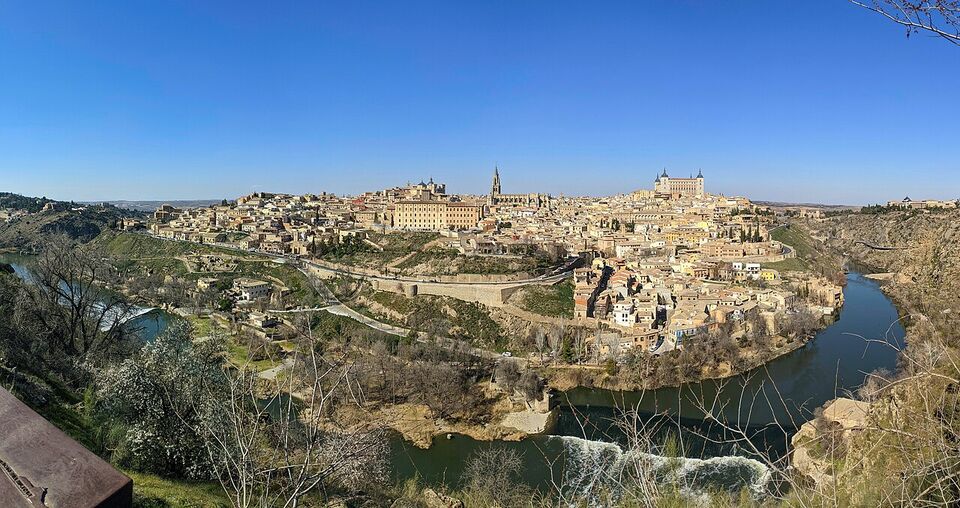
Toledo stands on a granite hill wrapped on three sides by a loop of the Tagus river, and it looks much as it did when El Greco painted it in the 1590s. It was the Visigothic capital, then a Moorish city, then the seat of Castile's kings, and for centuries Christians, Muslims and Jews lived here together, which is why it is called the City of Three Cultures. The old town is a UNESCO site, steep and maze-like, and wonderful once the tour groups leave in the late afternoon.
Getting there
Avant and AVE trains leave Atocha roughly every hour, with about 15 departures a day, and take about 33 minutes. Toledo's neo-Mudéjar station is worth a look in itself. From there, walk 20 minutes uphill, take a city bus or a taxi to Plaza de Zocodover, or walk to the foot of the old town and ride the free outdoor escalators up the hill.
What to see
- The cathedral. One of Spain's great Gothic cathedrals, with the Transparente (a baroque altarpiece lit by a hole cut in the vault), a sacristy hung with El Greco and Goya, and a treasury with a towering 16th-century gold and silver monstrance. Tickets cost about €12 (about $13), with reduced rates. It opens Monday to Saturday 10 am to 6:30 pm and Sunday 2 to 6:30 pm, with last entry 30 minutes before closing; it closes at 2 pm on December 24 and 31 and is closed on January 1 and December 25. Book on the cathedral's official site.
- El Greco's Burial of the Count of Orgaz. In the small church of Santo Tomé, where it was painted to hang. Arrive early; the room is tiny.
- The synagogues. Santa María la Blanca, a 12th- to 13th-century synagogue with horseshoe arches that looks like a mosque, and the Synagogue of El Tránsito, home to the state Sephardic Museum about Spain's Jewish history.
- Mosque of Cristo de la Luz. A tiny mosque from the year 999, one of the best-preserved buildings from Moorish Toledo.
- San Juan de los Reyes. A monastery built by Ferdinand and Isabella, with a beautiful two-level cloister.
- The El Greco Museum and the Alcázar. The first is a small state museum on El Greco's life; the second, the fortress at the top of town, holds the national Army Museum.
Save money
Toledo's pulsera turística (tourist wristband) has cost about €14 (about $16) and covers a set of churches and monuments over several days, including several of the sights above. The cathedral is not included. If you plan to see four or more of the covered sights, it pays for itself; check the current list at the first monument you visit.
Insider tip
The classic view of Toledo is from the Mirador del Valle on the road across the Tagus, best at sunset. Tourist buses and taxis go there, or you can walk the river road from either bridge if you have the time and the legs. Staying the night means you see the city lit up and nearly empty; Toledo's parador across the river has the famous view.
Toledo's sweet is mazapán (marzipan), sold in convents and pastry shops. In summer the town is very hot, often above 95°F (35°C), and the streets are steep, so start early and wear grippy shoes.
Segovia
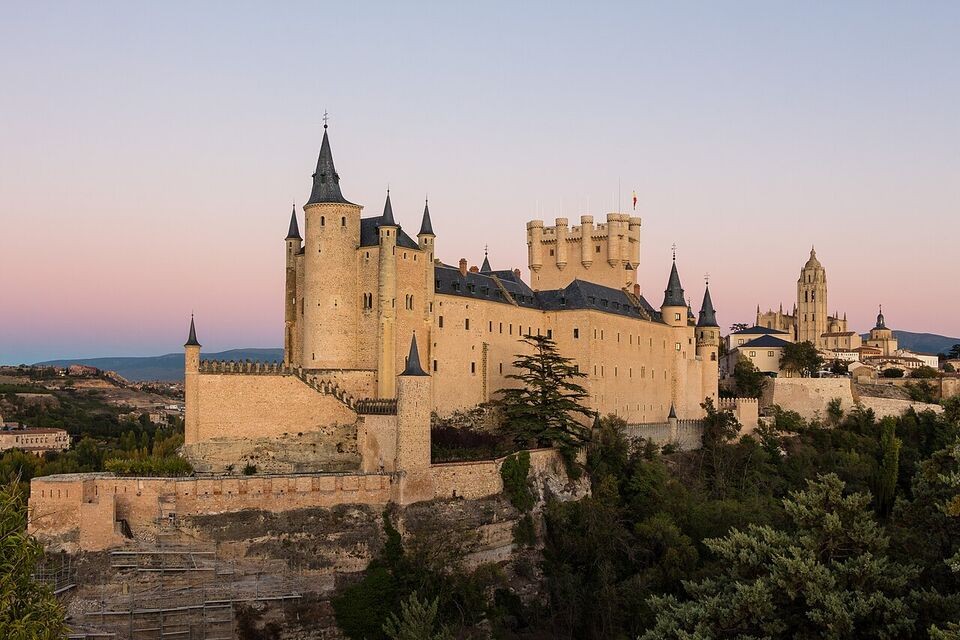
Segovia is the most photogenic town near Madrid, on a ridge between two rivers with the Guadarrama mountains behind. Its three great sights line up along one walk: the Roman aqueduct at the bottom, the cathedral in the middle and the Alcázar at the tip. The old town and aqueduct are a UNESCO site.
Getting there
High-speed trains from Chamartín reach Segovia-Guiomar station in about 27 minutes. City buses 11 and 12 meet trains and run to the aqueduct in about 15 to 20 minutes. Avanza buses from Moncloa take longer but drop you closer to the center.
What to see
- The aqueduct. Built by the Romans around the end of the 1st century AD, it brought water from the mountains, and its granite blocks stand without mortar. At its highest point in the Plaza del Azoguejo it is about 93 feet (28.5 m) tall. Free, and best seen from the steps beside it and from below at dusk.
- The cathedral. One of the last Gothic cathedrals built in Spain, from the 16th century, nicknamed "the lady of cathedrals". Tickets cost about €4 (about $4.50), or €7 (about $8) with the tower climb.
- The Alcázar. A castle on a cliff above the confluence of the rivers, with conical slate turrets, royal rooms and an artillery museum. It is often said to have inspired Disney's fairy-tale castles. Tickets have cost about €7 for the palace and museum, or about €10 (about $11) with the climb up the Torre de Juan II, which has the best view in town; check current prices on the official site. Tower tickets often sell out on weekends and holidays, so buy ahead.
Segovia's dish is cochinillo asado, roast suckling pig, so tender it is traditionally cut with the edge of a plate. Several old restaurants near the aqueduct have served it for generations. It is a big lunch; book ahead on weekends. Also try judiones de La Granja, giant white beans stewed with pork.
Insider tip
With a car or a taxi, add the Royal Palace of La Granja de San Ildefonso, about 7 miles (11 km) away, a Bourbon summer palace with French-style gardens and fountains. Entry costs €9 (about $10). The fountains run only on certain days, so check before you go.
Ávila
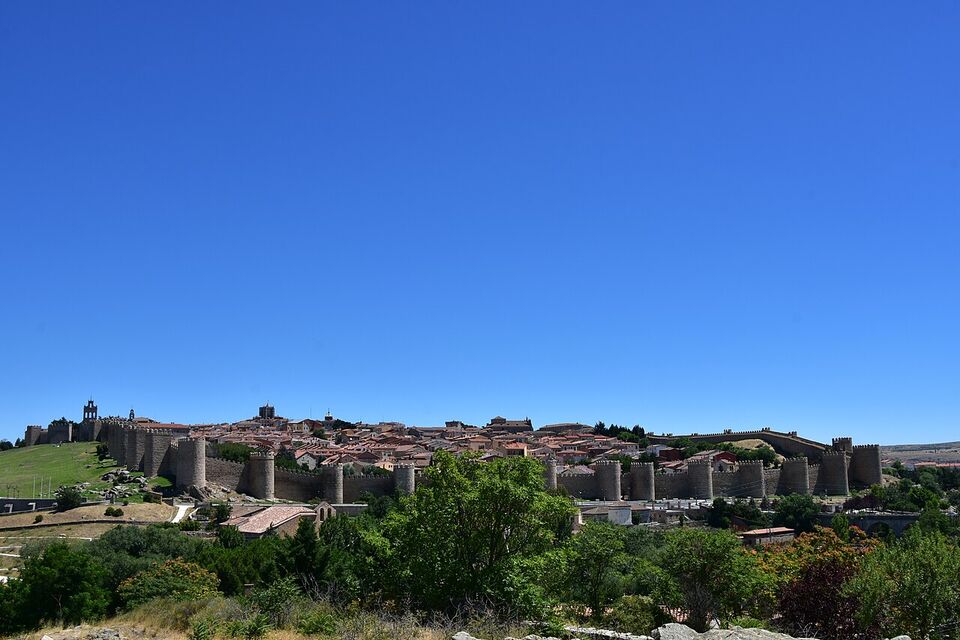
Ávila is ringed by the most complete medieval walls in Spain: about 1.5 miles (2.5 km) of stone with 87 towers and nine gates, built from the late 11th century. It is also the town of Saint Teresa of Ávila, the 16th-century mystic and reformer. At about 3,700 feet (1,130 m), it is the highest provincial capital in Spain, so it is cool in summer and cold in winter.
Getting there
Regional trains from Chamartín take about 1 hour 30 minutes to 2 hours, and departures are not frequent, so check the timetable and plan around it. The station is a 15-minute walk from the walls. Ávila pairs with Segovia in one long day by car, but by public transport it is a full day on its own.
What to see
- The walls. You can walk sections of the top. Tickets cost €8 (about $9), reduced €5. In winter (late October to late March) the walls open Tuesday to Sunday, 10 am to 6 pm, and close on Mondays; in July and August they stay open into the late evening. Entry is free on Tuesdays from 2 to 4 pm, except on and before holidays.
- The cathedral. Built partly into the walls, half church and half fortress.
- Basilica of San Vicente. A fine Romanesque church just outside the walls.
- Saint Teresa sites. The convent built on her birthplace and the Monastery of the Incarnation, where she lived for decades.
- Los Cuatro Postes. A small monument on a hill across the river with the best view of the whole walled town, a 15-minute walk from the walls.
Eat a chuletón de Ávila (a huge grilled beef rib steak) and buy yemas de Santa Teresa, rich egg-yolk sweets.
El Escorial
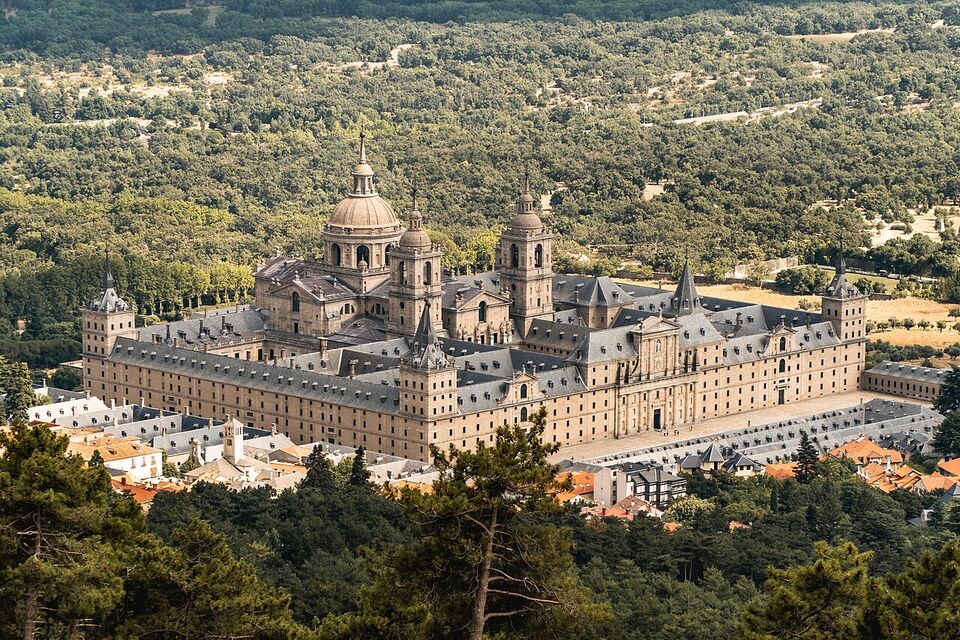
The Royal Monastery of San Lorenzo de El Escorial, built from 1563 to 1584 for Philip II, is a monastery, palace, basilica, library and royal mausoleum in one vast granite block in the foothills of the Guadarrama mountains. It is austere, imposing and a key to understanding Habsburg Spain.
Getting there
Bus 664 (and 661) from the Moncloa interchange takes about 50 minutes, runs frequently and stops in San Lorenzo de El Escorial, a short walk from the monastery; the fare is a few euros. Cercanías commuter trains from Atocha and Chamartín take about an hour to El Escorial station, about 1.2 miles (2 km) downhill from the monastery, with a local bus or an uphill walk through a park. Both are covered by the Zone T pass.
What to see
- The basilica, with its huge dome and gilded altarpiece.
- The Pantheon of Kings, a domed marble crypt holding most Spanish monarchs since Charles V, and the Pantheon of Princes.
- The library, a long barrel-vaulted hall with painted ceilings and some 40,000 volumes, one of the most beautiful rooms in Spain.
- Philip II's apartments, startlingly simple, with the window from which he could see the high altar from his bed.
- The art, with works by Titian, El Greco, Bosch and others.
Tickets cost €14 (about $16), reduced €7, and can be booked on the Patrimonio Nacional ticket site. It is closed on Mondays. The free afternoon slots on Wednesdays and Sundays are for EU and Latin American residents only.
Watch out
Many tours pair El Escorial with the Valle de Cuelgamuros, the former Valley of the Fallen, a vast monument and basilica built by Franco's regime partly with prisoner labor. Franco's remains were moved out in 2019, and the government is reshaping the site as a place of democratic memory. Entry costs €9 (about $10). It is a powerful but politically charged visit, and Spaniards feel strongly about it.
Alcalá de Henares
Alcalá, just east of Madrid, is the birthplace of Miguel de Cervantes and home to one of Europe's first planned university towns, founded by Cardinal Cisneros in 1499. The university and historic center are a UNESCO site. It is an easy half day.
- Getting there. Cercanías C2 or C7 from Atocha, about 35 to 40 minutes, every 15 minutes or so. Covered by the Zone T pass.
- Cervantes's birthplace (Museo Casa Natal de Cervantes). A re-created 16th-century house on the arcaded Calle Mayor. Free; closed Mondays.
- The university. The Colegio de San Ildefonso has a Plateresque facade and the Paraninfo hall, where the King presents the Cervantes Prize, the top award for literature in Spanish, each April 23. Guided tours run several times a day.
- Storks. Dozens of white storks nest on the church towers and rooftops for much of the year.
Alcalá is known for generous free tapas with drinks in its bars, and it is a student town, so it stays lively. Combine it with lunch and you are back in Madrid by evening.
Aranjuez
Aranjuez is a royal town on the Tagus, about 30 miles (48 km) south of Madrid, built around a Bourbon palace and miles of riverside gardens. Its cultural landscape is a UNESCO site. It is gentle, green and at its best in spring.
- Getting there. Cercanías C3 from Atocha in about 45 minutes, with frequent trains on weekdays and fewer on weekends. Covered by the Zone T pass.
- The Royal Palace. Tickets cost €9 (about $10), reduced €4; closed Mondays. The Casa del Labrador, a lavish small palace in the Jardín del Príncipe, has a separate ticket.
- The gardens. The Jardín de la Isla and the huge Jardín del Príncipe are free and lovely for a picnic or a bike ride.
- Food. Aranjuez is famous for strawberries and asparagus in spring.
- The Strawberry Train. The Tren de la Fresa, a vintage train from Madrid with costumed staff and strawberries, runs on set dates in spring. Check the year's schedule when it is announced.
Joaquín Rodrigo's Concierto de Aranjuez for guitar was inspired by these gardens; listen to it on the train down.
Cuenca
Cuenca is the most dramatic setting on this list: an old town on a narrow rocky spine between two river gorges, with medieval "hanging houses" whose wooden balconies jut out over the cliff. It is a UNESCO site, and it is further than the others, so start early or stay the night.
- Getting there. AVE trains from Atocha reach Cuenca-Fernando Zóbel station in about 55 minutes, with the first early in the morning. The station is about 4 miles (6 km) from the old town, so take the city bus that meets many trains, or a taxi.
- The hanging houses (Casas Colgadas). One holds the Museo de Arte Abstracto Español, a superb collection of Spanish abstract art from the 1950s and 1960s run by the Juan March Foundation. Entry is free; closed Mondays.
- San Pablo bridge. An iron footbridge over the Huécar gorge with the classic view back to the houses. It is high and a little bouncy.
- The cathedral. One of Spain's earliest Gothic cathedrals, with modern stained glass.
- Nature. With a car, the Ciudad Encantada (Enchanted City), a park of strange eroded rocks, is about 20 miles (30 km) away.
Cuenca's old town is steep, with long staircases and uneven paving. Wear good shoes, and expect cold winters and hot summer afternoons.
More ideas and overnights
- Chinchón. A village about an hour southeast by bus, with a wooden-balconied Plaza Mayor that becomes a bullring for festivals, anise liqueur and roast lamb. Best with lunch on a weekday.
- The Sierra de Guadarrama. Mountains about an hour north, with hiking from Cercedilla and the Puerto de Navacerrada, and snow in winter. See outdoors.
- Salamanca. About 1 hour 30 minutes by train from Chamartín, with Spain's most beautiful main square and a golden sandstone university. It deserves a night; see Salamanca and Castile.
- Córdoba or Valencia. Both are normally under two hours by high-speed train, so a very long day trip is possible, but each deserves more. After a fatal collision near Urda on October 28, 2026, Madrid–Andalusia high-speed trains were suspended and Renfe stopped selling tickets on the route until December 13, 2026, though service may return sooner; check Renfe, Iryo and Ouigo before planning Córdoba. See Córdoba and Valencia.
Toledo, Segovia and Cuenca are much better with a night. You see them in the evening and early morning without the crowds, and hotels cost less than in Madrid. Spain's state-run paradores (historic hotels) in Toledo, Cuenca, Chinchón and Segovia are good splurges; see where to stay in Spain.
Driving instead
A rental car is useful for combining Segovia and Ávila, for La Granja, Chinchón and the Ciudad Encantada, or for continuing to Salamanca. Pick it up at the edge of Madrid rather than downtown, and park outside the old towns, which have narrow streets and restricted zones with cameras. Speed limits on autovías are 120 km/h (75 mph). See driving in Spain.
When to go and what goes wrong
- Mondays. El Escorial, Aranjuez, Cuenca's museums and Alcalá's Cervantes house are closed, and so are Ávila's walls from late October to late March. Use Monday for Toledo or Segovia.
- Sundays. Toledo Cathedral opens only in the afternoon, from 2 pm. Weekends bring Madrid crowds to every town on this page, so go midweek if you can.
- Holidays. Easter week (Semana Santa) brings processions to Toledo, Cuenca and Ávila, and full trains. Cuenca's Holy Week, with its music week, is famous. Book trains and hotels early. See festivals.
- Weather. Toledo, Aranjuez and Cuenca can be very hot from June to September; start early and rest in the afternoon. Ávila and Segovia are cold in winter and sometimes snowy. Pack layers.
- Last trains. The last trains back to Madrid can sell out, especially on Sunday evenings. Book your return when you book your outward trip.
- Station distances. Segovia-Guiomar and Cuenca's high-speed station are far from the old towns; allow 30 minutes for the bus each way in your plan.
Watch out
Free afternoons at Patrimonio Nacional sites (El Escorial, Aranjuez, La Granja) are for EU or Latin American residents, and the Alcázar of Segovia's free Tuesday afternoon slot (2 to 4 pm) is for EU citizens only; you will be asked for ID. Prices on this page are 2026 rates; Spanish sites often adjust them in January, so check the official site the week you travel.
Add it to a route in the trip builder, or ask us to plan the hotels, trains and guides for you.