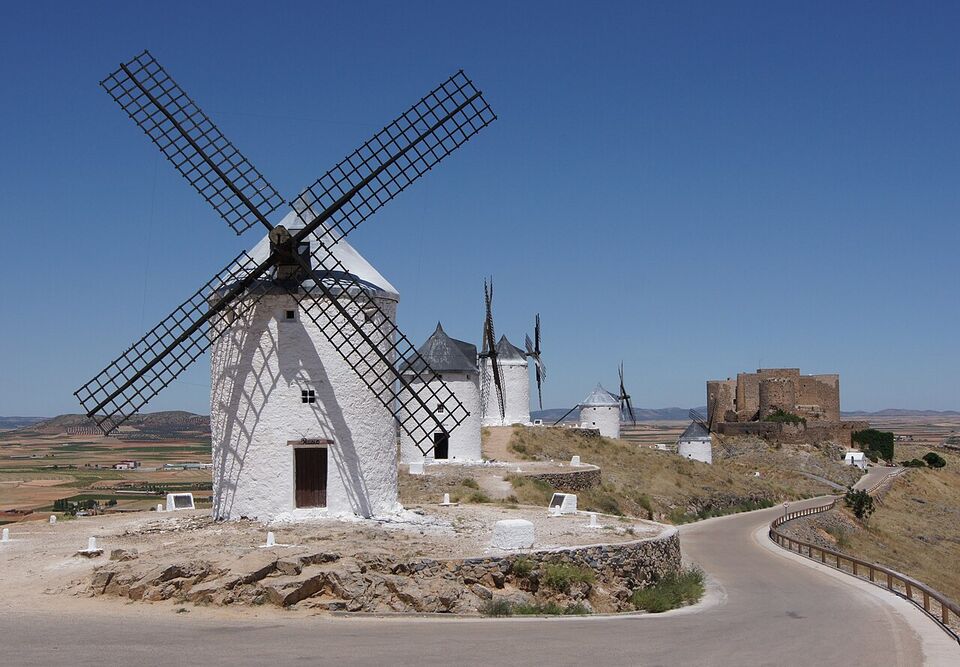
Tap a dot to open that destination's guide. Hover over a region to see its name. The Canary Islands are shown in the box at lower left, closer than they really are.
- Regions
- 17 autonomous communities plus the North African cities of Ceuta and Melilla
- Languages
- Spanish everywhere; Catalan, Basque and Galician are co-official in their regions
- Hub
- Madrid, at the center of the high-speed rail network
- Time zones
- Mainland and Balearics on Central European Time; the Canary Islands one hour behind
- Default transport
- High-speed trains (Renfe AVE, Iryo, Ouigo) between cities; a car for villages and the countryside
- First trip
- Madrid plus Barcelona or Andalusia, 10–14 days
How Spain fits together
Spain covers about 195,000 square miles (505,000 km²), roughly twice the size of Oregon, and most of the interior is a high, dry plateau called the meseta with Madrid in the middle. Around it sit very different places: Catalonia and Valencia on the Mediterranean, Andalusia in the hot south, the rainy green north from the Basque Country to Galicia, and two island groups, the Balearics in the Mediterranean and the Canaries off the coast of West Africa.
The regions carry real weight: each runs its own health system, in some cases its own police, and sets its own tourist taxes and festival calendar. In Barcelona street signs are in Catalan first, in San Sebastián you will see Basque (Euskara) on every menu, and in Santiago de Compostela the local language is Galician. Everyone also speaks Spanish, and nobody expects a visitor to know the others, though a word of thanks in the local language goes down well (see Spanish phrases).
For trip planning, the key fact is the rail map. Spain has Europe's longest high-speed network, and almost all of it radiates from Madrid. Madrid to Seville, Málaga, Valencia or Barcelona is a morning on the train, and Córdoba, Segovia and Toledo are day trips. Crossing the country without passing through Madrid is slower, and the islands and parts of the north are easier by air.
Watch out
After a fatal collision near Urda (Toledo) on October 28, 2026, high-speed trains between Madrid and Andalusia were suspended; Renfe stopped selling tickets on the route until December 13, 2026, though service may return sooner. Check Renfe, Iryo and Ouigo before you plan, and consider flying or taking a long-distance bus in the meantime. Earlier in the year, after the January 2026 derailment near Adamuz, in Córdoba province, which killed 46 people, the same line closed for about a month and kept temporary speed limits near Córdoba. Madrid–Barcelona trips can also take longer than the fastest timetables of past years. The times on this page are typical fastest times when the lines run normally; check the live timetable when you book (see getting around Spain).
Madrid and central Spain
Madrid is where most trips start and end, with the most nonstop flights from the US and the hub of the rail network. Give it three full days for the Prado, the Reina Sofía, the Royal Palace and the late-night tapas culture. Toledo is about 33 minutes away by high-speed train and Segovia about 30, so the old Castilian cities fit around a Madrid stay. Further northwest, Salamanca, León and Burgos reward an overnight.
Madrid
Three of Europe's great art museums within a 15-minute walk, the Royal Palace, the Retiro park, and a food and nightlife scene that runs late even by Spanish standards. Also see the sights and tickets and where to eat and drink.
Day trips from Madrid
Toledo's cathedral and Jewish quarter, Segovia's Roman aqueduct and Alcázar, the walls of Ávila, Philip II's monastery at El Escorial, Alcalá de Henares and Cuenca's hanging houses.
Salamanca and Castile
Salamanca's golden sandstone university town, the stained glass of León's cathedral, Burgos and its Gothic cathedral, castles, and the Ribera del Duero wine route. Quieter, cheaper and very Spanish.

Barcelona, Catalonia and the northeast
Barcelona is Spain's second city and its own world: Gaudí, the Gothic Quarter, beaches inside the city, and Catalan food and language. It also has Spain's most crowded sights, its worst pickpocketing and a tourist tax that has been rising. Book Park Güell before you fly, and check the Sagrada Família first: on November 1, 2026 the official ticket page said the basilica was temporarily closed to the public, with no reopening date given, so check sagradafamilia.org before you plan around a visit. North of the city, Girona is about 40 minutes by high-speed train and the Costa Brava starts an hour or so beyond.
Barcelona
Neighborhoods, getting around, the airport and the tourist tax. Then plan the Gaudí sights, markets and museums and Sagrada Família tickets.
Girona and the Costa Brava
Girona's walled old town, the Dalí Theatre-Museum in Figueres, the whitewashed harbor of Cadaqués, coves and coastal paths, plus Montserrat and Sitges as day trips from Barcelona.
Madrid vs Barcelona
Only time for one? How the two cities differ on art, food, beaches, crowds, cost and nightlife, and how to split your days if you do both.
Andalusia and the south
Andalusia is the Spain of most Americans' imagination: flamenco, Moorish palaces, whitewashed hill towns, sherry and orange trees. It is also big, about the size of Indiana, and very hot from June to September. The classic route links Seville, Córdoba and Granada, with Málaga as the beach-and-airport end. Córdoba is about 45 minutes from Seville by high-speed train, Granada about 1 hour 30 minutes from Córdoba, and Málaga about an hour from Córdoba. The times from Madrid on the cards below apply when the Madrid–Andalusia line is running; it was suspended after the October 28, 2026 collision (see the warning above).
Seville
The Real Alcázar, the cathedral and Giralda, Triana and the river, tapas bars that open at 8 p.m., Holy Week and the April Fair. The best base for the south.
Córdoba
The Mezquita-Catedral, a mosque with a cathedral built inside it, plus the old Jewish quarter, the flower-filled patios of May and the caliphs' ruined city of Medina Azahara.
Granada
The Alhambra above, the Albaicín's lanes below, free tapas with your drink, and the Sierra Nevada behind. Start with how to get Alhambra tickets, which sell out weeks ahead.
Andalusia road trip
Ronda's gorge, the white towns of Arcos, Grazalema, Zahara and Vejer, Cádiz, Jerez's sherry bodegas and horses, and the wetlands of Doñana.
Málaga and the Costa del Sol
Málaga's Picasso Museum and food scene, the beaches of Marbella and Nerja, and the busiest airport in the south, where United has flown a seasonal summer nonstop from Newark.
Valencia and the east coast
Valencia is about 1 hour 50 minutes from Madrid by high-speed train and about 3 hours from Barcelona along the coast. It is Spain's third city, the home of paella, and a good pick for families: a long city beach, a riverbed turned into a 5-mile (9 km) park, and the futuristic City of Arts and Sciences. In March it hosts Las Fallas, one of Spain's loudest festivals.
Valencia
The old town, the Central Market, the Turia gardens, real paella in the Albufera rice fields, Las Fallas, and how the area has recovered from the October 2024 floods.
The green north
The north coast, from the French border to Galicia, is cooler, greener and rainier than the rest of Spain, and it is where many Spaniards spend August. It has the country's most celebrated food (San Sebastián's pintxos, small snacks on bread; Galician seafood; Asturian cider) and some of its best hiking. Distances are longer and trains slower here, so many people fly to Bilbao, Santander, Asturias or Santiago and rent a car.
The Basque Country
San Sebastián's pintxo bars and La Concha beach, Bilbao and the Guggenheim, fishing towns along the coast, and a language unrelated to any other in Europe.
Rioja and Navarra
Wineries from tiny family cellars to designer bodegas, Logroño's tapas street, and Pamplona, where the running of the bulls takes over July 6 to 14.
Asturias and Cantabria
The Picos de Europa mountains, Santander's bay, the Altamira cave replica, cider houses and a rugged coast of coves and fishing ports.
Galicia
Santiago de Compostela and its cathedral, A Coruña, the fjord-like Rías Baixas, Albariño wine and octopus. The end point of the Camino de Santiago.
The islands
Spain's islands are separate trips, best for a beach week or a few days at the end of a mainland trip. The Balearics are a short flight from Madrid or Barcelona (about 1 hour 15 minutes and 55 minutes to Palma), with overnight ferries from Barcelona and Valencia. The Canaries are a 2 hour 30 minute to 3 hour flight from Madrid and stay warm all winter, which makes them Europe's winter sun destination.
Mallorca and the Balearics
Palma's cathedral and old town, the Tramuntana mountains, coves, Menorca's quieter beaches, Ibiza beyond the clubs, and Formentera. Expect a per-night tourist tax and summer crowds.
The Canary Islands
Mount Teide on Tenerife, the dunes of Gran Canaria, Lanzarote's volcanic landscapes, hiking on La Palma and the long beaches of Fuerteventura. One hour behind the mainland.
Travel times from Madrid
These are typical fastest direct times when the lines run normally. Many departures are slower, Madrid–Andalusia trains were suspended after the October 28, 2026 Urda collision (see above), and speed limits can add time on the Barcelona and Andalusia lines. Book trains on the operators' own sites (Renfe, Iryo, Ouigo); fares rise as departure nears, and the cheapest seats go weeks out.
| Destination | Fastest train | Flight | Notes |
|---|---|---|---|
| Toledo, Segovia | About 30 min | None | Easy day trips |
| Salamanca | About 1 hr 35 min | None | León about 2 hr; Burgos about 1 hr 30 min |
| Córdoba | About 1 hr 45 min | None | Suspended from Madrid after Oct 28, 2026; check Renfe |
| Valencia | About 1 hr 50 min | None worth taking | Train beats the plane door to door |
| Seville | About 2 hr 30 min | About 1 hr 5 min | Suspended from Madrid after Oct 28, 2026; fly meanwhile |
| Málaga | About 2 hr 45 min | About 1 hr 10 min | Train suspended from Madrid after Oct 28, 2026; check Renfe |
| Barcelona | About 2 hr 30 min to 3 hr | About 1 hr 15 min | Can run longer than past timetables; check |
| Granada | About 3 hr 20 min | About 1 hr | Train suspended from Madrid after Oct 28, 2026; check Renfe |
| Santiago de Compostela | About 3 hr 30 min | About 1 hr 15 min | High-speed line via Ourense |
| Oviedo | About 3 hr 30 min | About 1 hr | Via the newer Pajares tunnels |
| Logroño, Pamplona | About 3 hr to 3 hr 30 min | Pamplona about 1 hr | A car helps for the wineries |
| Bilbao, San Sebastián | About 5 hr | About 1 hr 5 min | Most visitors fly or drive |
| Palma de Mallorca | None | About 1 hr 15 min | Ferries from Barcelona or Valencia |
| Tenerife, Gran Canaria | None | About 2 hr 30 min to 3 hr | Clocks one hour earlier on arrival |
Different from home
Spanish high-speed trains feel more like a domestic flight than Amtrak: you scan your bag at security, the train leaves on the minute, and seats are assigned. Arrive 20 to 30 minutes early at big stations such as Madrid Atocha or Barcelona Sants. Fares are dynamic like airline tickets, so a seat that costs €30 (about $34) a month out can cost €100 (about $112) the week before.
How to combine destinations
The simplest rule: plan two or three nights per base, three or more for Madrid, Barcelona and Seville, and use Madrid as the hinge. Most Americans try to see too much on a first trip. Ten days comfortably covers two big cities and one region; two weeks covers three.
Book an open-jaw flight (into one city, out of another) so you never backtrack. Madrid and Barcelona have year-round nonstops to the US and Málaga a seasonal one, and many more routes connect through European hubs; see flights from the US. For timings and full day-by-day plans, see planning your trip.
Classic first trips
- 10 days
Madrid and Barcelona
Four nights in Madrid with a day trip to Toledo or Segovia, then the train to Barcelona for four nights, with a half day in Girona or Montserrat. Fly into one city and out of the other.
- 10 days
Madrid and Andalusia
Three nights in Madrid, then the train (or a flight, while the Madrid–Andalusia line is suspended) to Seville for three nights with a day in Córdoba, then two or three nights in Granada for the Alhambra. Fly home from Málaga or take the train back to Madrid.
- 14 days
The big three
Barcelona (four nights), fast train to Madrid (three nights), then Seville (three), Córdoba (one) and Granada (two), finishing in Málaga. Barcelona to Seville also has direct trains of about 6 hours when the Madrid–Andalusia line is running, or a flight of about 1 hour 45 minutes, if you want to skip Madrid.
Second trips and special interests
- Food lovers. Fly into Bilbao, then San Sebastián (three nights), Rioja (two nights) and back via Madrid. Add Madrid's tapas bars and read Spanish food region by region and Spanish wine.
- The green north by car. Bilbao, Santander, the Picos de Europa, Oviedo and Santiago de Compostela over 10 to 12 days, mostly by rental car; see driving in Spain.
- Walking. The last 62 miles (100 km) of the Camino de Santiago take five to seven days, from Sarria to Santiago.
- Beach and city. Barcelona plus a week on Mallorca or Menorca, or Málaga plus the Costa del Sol. In winter, the Canaries are the only reliable beach weather in Spain.
- Beyond Spain. Seville and Lisbon pair well, and Tarifa has ferries to Tangier in Morocco; see Spain with Portugal, France and Morocco.
Insider tip
A one-way car rental that starts in one Spanish city and ends in another usually costs a modest drop fee, but dropping a car in Portugal or France costs far more. If you want to drive in Andalusia or the north, take the train to your first base and rent there, rather than driving out of Madrid or Barcelona.
Which region fits you?
- Your first trip. Madrid and Barcelona, or Madrid plus Seville and Granada. All by train, no car needed.
- Art and architecture. Madrid's Prado, Barcelona's Gaudí buildings, the Alhambra, the Mezquita, Bilbao's Guggenheim. See art and architecture.
- Flamenco. Seville, Jerez and Granada, with Madrid's tablaos a close fourth. See where to see flamenco.
- Festivals. Holy Week in Seville, Las Fallas in Valencia, San Fermín in Pamplona, the patios of Córdoba in May. See the festival calendar.
- Families. Valencia, Barcelona, Málaga and the islands, where beaches and parks break up the sightseeing. See Spain by interest.
- Hiking and outdoors. The Picos de Europa, the Pyrenees, the Sierra Nevada, Mallorca's Tramuntana and the Canaries. See the outdoors.
- Fewer Americans. Castile and León, Galicia, Asturias and the white towns of inland Andalusia.
Seasons by region
Spain's climates vary as much as its food. Andalusia and the interior are best from March to May and from late September to November; July and August regularly bring 100°F (38°C) heat to Seville, Córdoba and Madrid. The north is at its best from June to September and wet in winter. The Mediterranean coast is warm from May to October, and the Canaries hover around 70°F (21°C) all year.
August is Spain's own vacation month: the beaches and islands are full and expensive, while some family restaurants and shops in Madrid and other cities close for two or three weeks. Holy Week (March 21 to 28, 2027) and the big festivals push hotel prices up sharply in their host cities. Month-by-month detail is on when to go, with special pages for November, December and January.
Save money
Seville, Córdoba, Granada and Madrid are pleasant and noticeably cheaper from November to February, apart from Christmas and New Year. Hotels in Seville can cost half their Holy Week or April Fair rates, and the Alhambra and Mezquita are far less crowded.
Tourist taxes by region
Spain has no national tourist tax. Catalonia (including Barcelona, which adds its own city surcharge) and the Balearic Islands charge per person, per night, collected by your hotel or rental host, and both have raised their rates in recent years. A few cities elsewhere, including Santiago de Compostela and A Coruña in Galicia, have added smaller municipal charges, and Basque cities such as San Sebastián plan their own from January 2027 (check final rates). Andalusia, Madrid, the Valencia region, the Canary Islands and most other regions had no tourist tax as of November 2026, although Seville's mayor has been pressing the regional government for permission to introduce one. Current rates are on money and costs and where to stay.
Add it to a route in the trip builder, or ask us to plan the hotels, trains and guides for you.